
Quick Answer
Before planning a custom home in Northern Colorado, ask questions about the property, site conditions, budget, floor plan, process, communication, and builder fit.
The right questions help you understand whether the land, design direction, investment range, and building process are aligned before major decisions are made.
This is especially important in Northern Colorado, where city lots, acreage, foothill settings, growing communities, and Front Range views can each shape the home in practical ways.
Table Of Contents
- Start With Location And Property Fit
- Ask What The Land May Change
- Discuss Budget And Scope Early
- Ask How The Floor Plan Will Be Evaluated
- Clarify The Process And Communication Rhythm
- Talk About Northern Colorado Lifestyle Needs
- Compare Builder Fit Without Rushing
- Planning Questions Checklist
- FAQ
Many homeowners begin the custom home process with a vision for the finished home. That vision matters. But before the design becomes too fixed, it is worth slowing down and asking the questions that shape the experience behind the home.
In Northern Colorado, those questions are not only about style. They are about the property, budget, site work, access, utilities, views, outdoor living, design coordination, and the way the builder communicates throughout the process.
The goal is not to make the process feel heavier. The goal is to make it clearer.
Start With Location And Property Fit
Northern Colorado is not one simple building context.
A home near Fort Collins may involve different questions than a home in Windsor, Timnath, Loveland, Berthoud, Erie, Niwot, Boulder County, or a more rural foothill setting. A city lot, acreage parcel, established neighborhood, and growing-community homesite can each affect planning in a different way.
That is why one of the first questions to ask is whether the builder understands the type of property and location you are considering.
Helpful questions include:
- Do you build in the community where my property is located?
- What kinds of Northern Colorado properties do you know best?
- Have you worked with city lots, acreage, foothill settings, or growing-community lots like mine?
- What local conditions should we discuss before design moves too far?
The answer should feel specific. A strong builder should be able to explain how location may affect access, budget, design, permitting, schedule, and the overall path to construction.
Ask What The Land May Change
The land can have a major influence on a custom home.
Views may affect orientation. Slope may affect driveway access, excavation, drainage, foundation design, and outdoor living. Utilities may affect budget and timeline. Soil conditions may require additional evaluation. Wind, privacy, sun exposure, and fire mitigation may also shape the design.
A beautiful property can still be the right property. It simply needs to be understood clearly.
Questions to ask include:
- When should we review the property together?
- What site conditions could affect the design or budget?
- How do utilities, access, slope, soil, drainage, and views affect planning?
- If I am still looking for land, what should I ask before buying?
If you are building on land you already own, this conversation can help clarify what the site will require. If you are still searching, early builder input can help you compare properties with more confidence.
For a deeper look at this part of the process, see Building On Your Lot in Colorado.
Discuss Budget And Scope Early
Budget clarity should begin before design decisions go too far.
A custom home budget is shaped by more than square footage. Site work, structural complexity, rooflines, window packages, exterior materials, interior finishes, garage needs, outdoor living areas, and local requirements can all affect the full scope.
That does not mean every number will be final at the beginning. It means the early conversation should be grounded in real assumptions.
Questions to ask include:
- How do you help create an early budget range?
- What assumptions are included in that range?
- What usually changes the budget as planning continues?
- How do you help homeowners decide where to invest and where to simplify?
- How are changes reviewed and documented?
The right builder should help you understand tradeoffs calmly. A larger window package, more complex roofline, longer driveway, or more detailed finish level may be worth it. The important thing is knowing what each choice means before the project is too far along.
Ask How The Floor Plan Will Be Evaluated
A floor plan should fit the land and the way you want to live.
Some homeowners begin with an existing plan and adjust it. Others need a more custom design from the beginning. Either path can work when the plan is evaluated against the property, budget, lifestyle, views, garage needs, storage, and outdoor living goals.
Questions to ask include:
- Can we start with an existing plan?
- How much can the plan be adjusted?
- How do you review a floor plan for the property, views, garage, and outdoor living?
- How do you help make sure the plan fits the budget?
- What should we decide before the plan becomes too fixed?
The strongest floor plans usually come from alignment. The land, layout, daily routines, and investment range should be working together.
You can also explore NoCO’s Floor Plans and Custom Floor Plans resources as a starting point for this conversation.
Clarify The Process And Communication Rhythm
A custom home involves hundreds of decisions. The process matters because it determines how those decisions are made, tracked, and communicated.
Before choosing a builder, ask how the relationship will work once planning begins. Who guides the process? How often will you receive updates? How are selections documented? How are changes reviewed? How are architects, designers, engineers, and trade partners coordinated?
Questions to ask include:
- Who will be our main point of contact?
- How often will we receive updates?
- How are selections, questions, and changes documented?
- How do you coordinate the builder, designer, architect, engineer, and trades?
- What happens when a decision needs more detail?
Good communication does not mean the project will never involve questions or changes. It means there is a clear way to handle them.
NoCO’s Our Process page can help you understand how the early planning conversation fits into the larger build path.
Talk About Northern Colorado Lifestyle Needs
A custom home should support the way life actually happens.
In Northern Colorado, that may include outdoor living, views, sun exposure, mudrooms, garage space, gear storage, pets, work-from-home space, guest rooms, flexible rooms, or areas that can support family needs over time.
These are lifestyle questions, but they are also design questions.
Helpful questions include:
- How should the home support outdoor living?
- What should we consider for gear, vehicles, bikes, pets, or seasonal storage?
- How can the home make the most of views and natural light?
- What spaces should be flexible over time?
- How should the home handle guests, family, and daily routines?
Details like these can change the floor plan, storage strategy, garage layout, outdoor connections, and finish decisions. They are worth discussing before the design becomes too rigid.
Compare Builder Fit Without Rushing
Choosing a builder is a significant decision. It is reasonable to compare carefully.
Start with relevant experience, a clear process, a portfolio that reflects the type of home you want to build, and answers that feel specific to your property and priorities. The goal is not to rush toward the most polished claim. The goal is to understand which team can guide your project with clarity and care.
Questions to ask include:
- Can I see examples of similar homes?
- Can you explain your process clearly?
- What should I expect before construction begins?
- What do past homeowners usually value about working with you?
- What should be in writing before we move forward?
It can also help to review a builder’s Portfolio and related regional guidance, such as How To Choose a Custom Home Builder in Northern Colorado and Choosing a Custom Home Builder in Fort Collins.
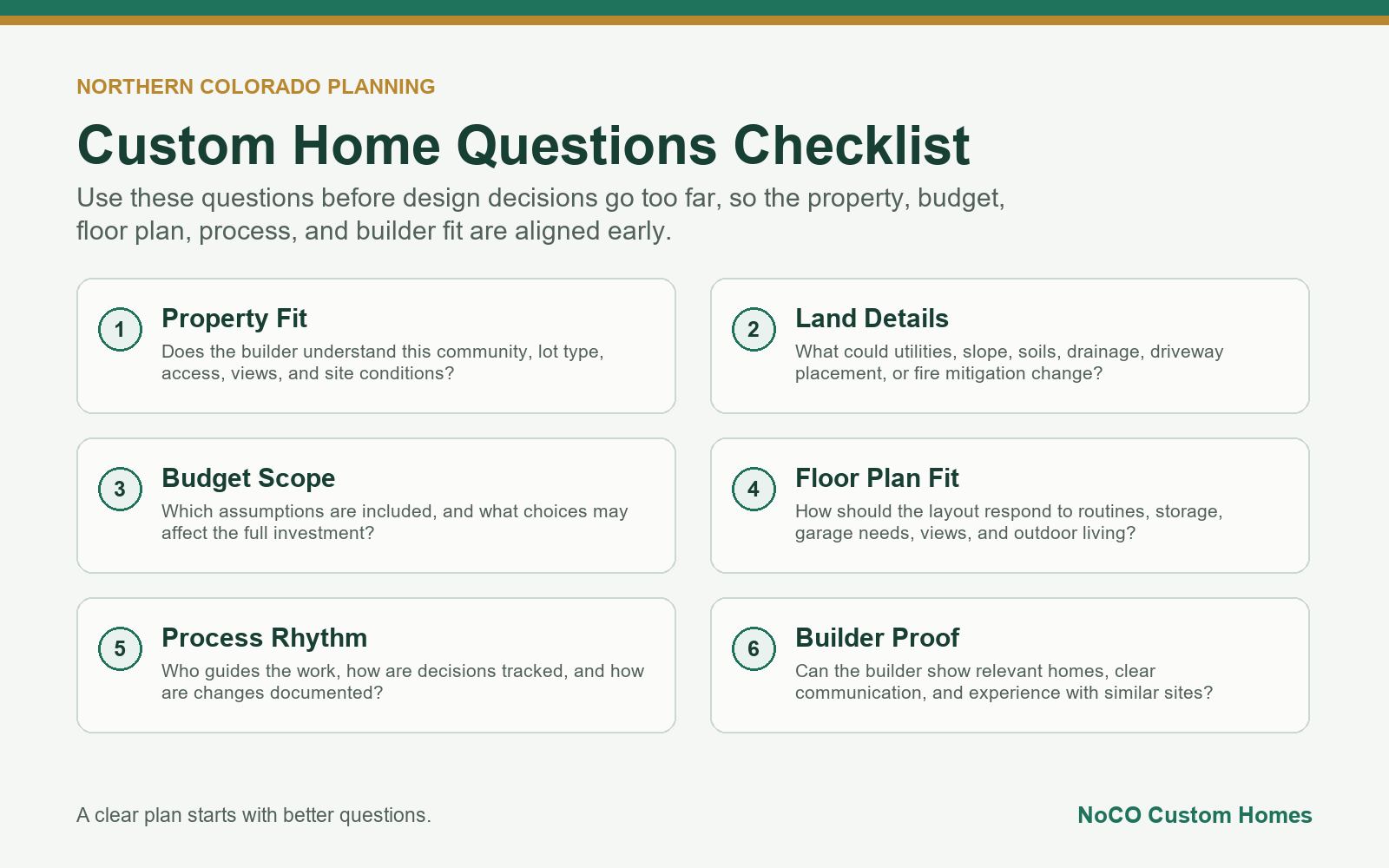
Planning Questions Checklist
Use this checklist as a starting point before your first serious builder conversation.
FAQ
What should I ask first when planning a custom home in Northern Colorado?
Start by asking how the property, location, budget, and design goals should be evaluated before the plan moves too far. Those early answers often shape the rest of the process.
Should I talk to a builder before buying land?
In many cases, yes. A builder can help you understand site conditions, utilities, access, slope, drainage, views, and other details that may affect design, budget, and timing.
Why does local experience matter for Northern Colorado homes?
Local experience matters because different communities and property types can create different planning needs. A builder who understands the region can help connect the land, design, process, and budget more clearly.
How do I compare Northern Colorado custom home builders?
Compare relevant experience, process clarity, communication style, portfolio fit, site knowledge, budget guidance, and how specifically each builder answers questions about your property and goals.
What should I bring to an early builder conversation?
Bring your property address or lot information if you have it, early design ideas, preferred communities, budget expectations, lifestyle needs, inspiration images, and any questions about process, timing, or feasibility.
Related NoCO Resources
- How To Choose a Custom Home Builder in Northern Colorado
- Choosing a Custom Home Builder in Fort Collins
- Building On Your Lot in Colorado
- Floor Plans
- Custom Floor Plans
- Our Process
- Contact NoCO Custom Homes
The Takeaway
The best custom homes do not start with rushed decisions. They start with the right questions, a clear view of the property, and a process that connects design, budget, and expectations early.
If you are beginning to plan a custom home in Northern Colorado, NoCO Custom Homes can help you think through the decisions that matter before the project moves too far forward.