
Quick Answer
A custom home builder’s portfolio can help you understand style, project range, layout thinking, site response, and the kinds of details the team chooses to photograph. Use those images to form better questions, not to make a final decision by appearance alone. Compare several projects, look for homes relevant to your goals, and verify what the photos cannot show through process conversations, references, project context, and appropriate in-person review.
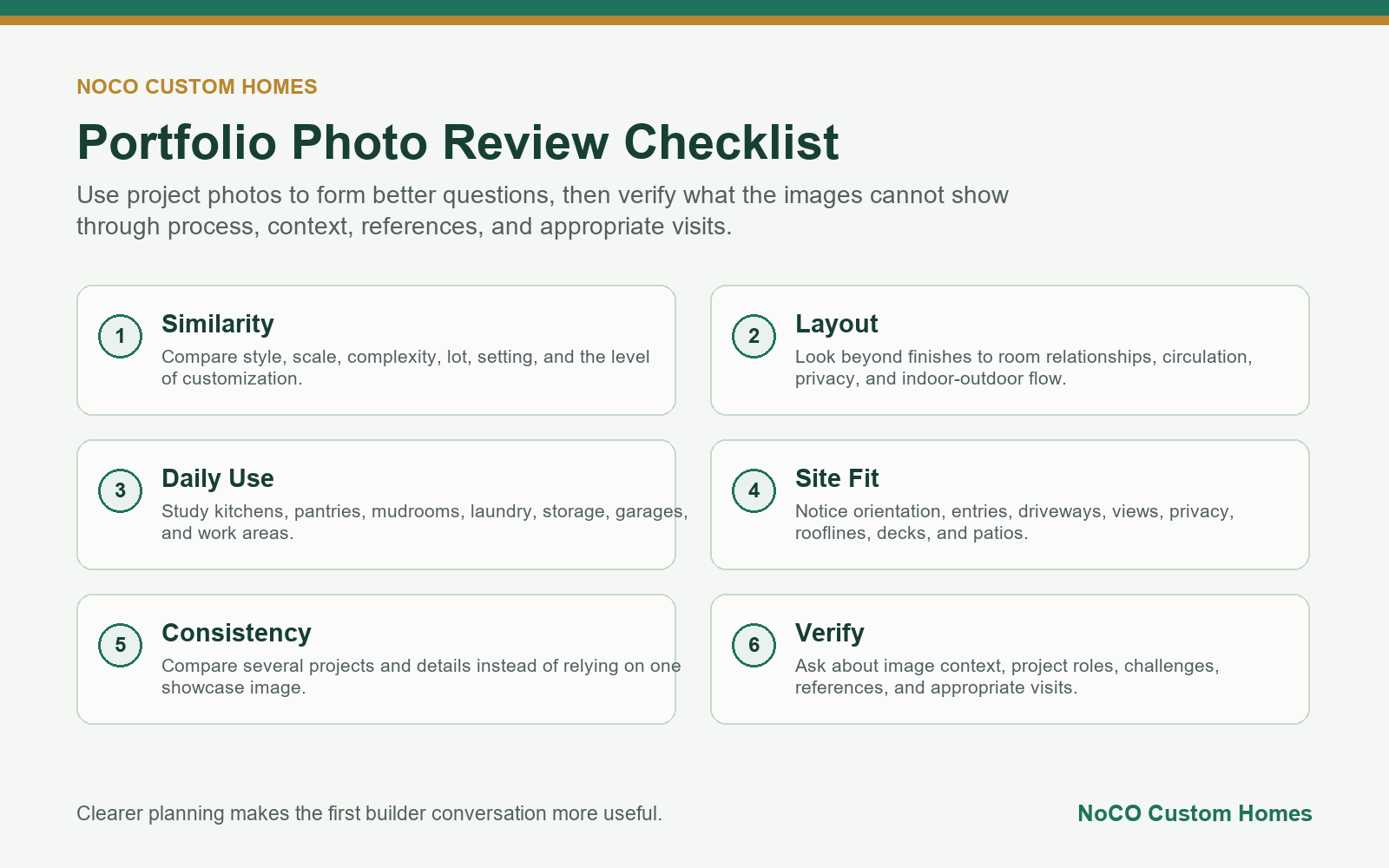
Table Of Contents
- Begin With Project Similarity
- Look At Layout, Not Only Finishes
- Study Everyday Spaces
- Review Site Fit And Outdoor Living
- Compare Details Across Several Projects
- Separate Photography From Proof
- Work Through A Verified NoCO Example
- Ask What The Photos Do Not Show
- Use A Portfolio Photo Review Checklist
- FAQ
Begin With Project Similarity
The most dramatic home in a portfolio is not always the most useful comparison. Start by looking for projects that share something meaningful with the home you are considering: architectural direction, number of levels, overall scale, lot type, garage needs, outdoor living, view conditions, or the level of customization.
Similarity does not mean your home should copy another project. It gives you a practical starting point for asking how the builder approached comparable constraints and priorities. Ask which completed projects the team considers most relevant to your property and goals, and why.
Look At Layout, Not Only Finishes
Portfolio photography naturally draws attention to cabinetry, tile, lighting, countertops, and furniture. Those details matter, but the relationships between spaces may tell you more about how a home supports daily life.
Look for the connection between the kitchen and gathering areas, the path from the garage to the pantry, privacy between bedrooms and shared rooms, circulation around stairs, sightlines, ceiling transitions, natural light, and the relationship between indoor and outdoor spaces. Then compare those observations with NoCO’s Floor Plans to think about how a photographed room might fit into a complete home.
Study Everyday Spaces
A portfolio may lead with great rooms and primary suites, but everyday spaces often reveal whether a design was organized around real routines. Look for pantries, mudrooms, laundry rooms, garages, closets, work areas, drop zones, and storage near the places where it will be used.
Notice whether the photos show more than one angle. A tightly cropped image may highlight a beautiful feature without explaining circulation, storage, or the connection to the next room. Ask for context when a space is especially relevant to your plans.
Review Site Fit And Outdoor Living
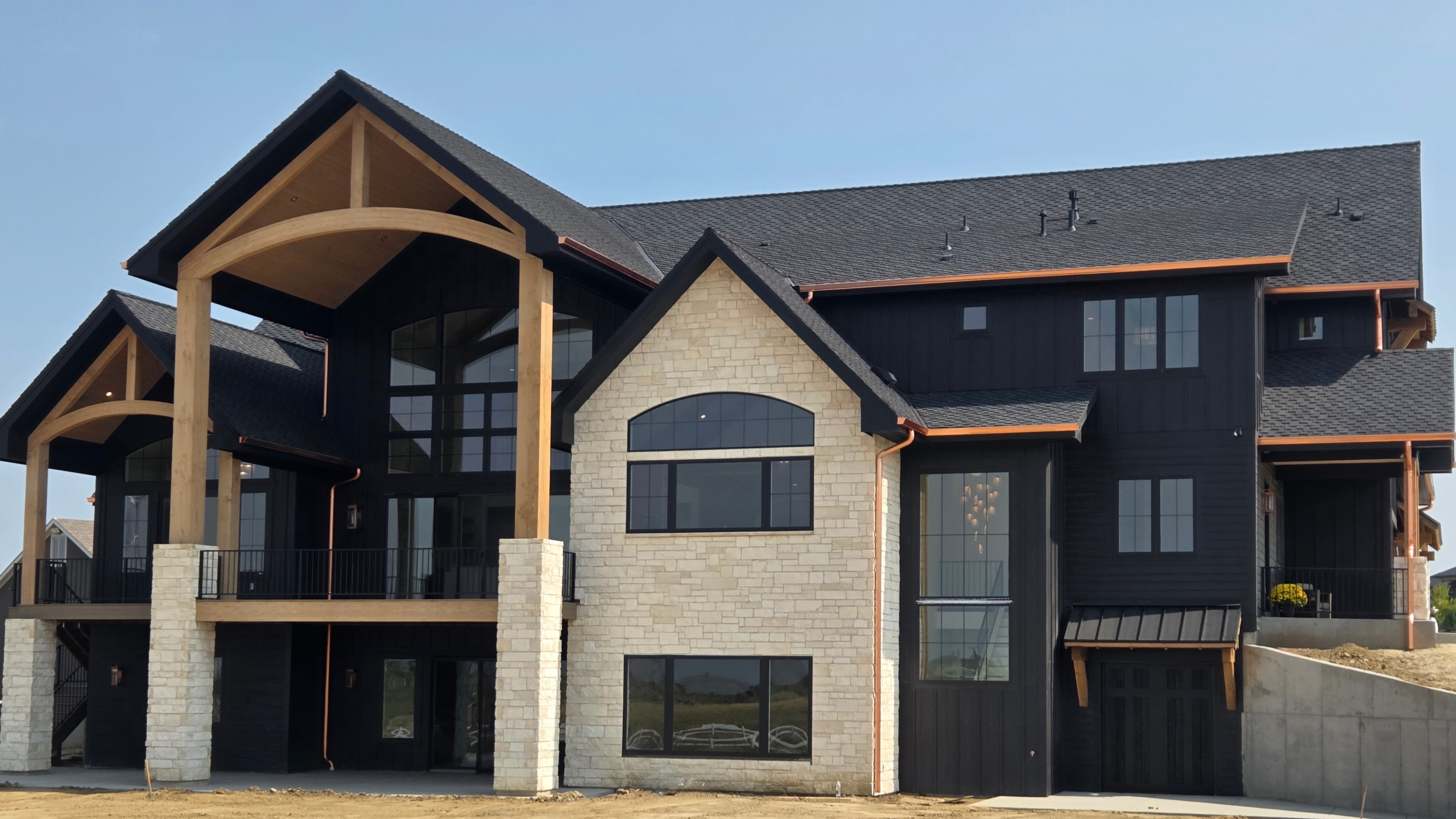
Exterior photos can help you ask how a home responds to its property. Study how the building sits on the land, where the driveway and garage meet the home, how entries are protected, where outdoor rooms are placed, and how windows, decks, patios, rooflines, privacy, views, and sun appear to relate.
Photography cannot reveal every site condition or design constraint. Ask what shaped the orientation and whether the example involved slope, access, drainage, exposure, or a particular view strategy. If property fit is central to your project, pair the portfolio review with NoCO’s Building On Your Lot in Colorado resource.
Compare Details Across Several Projects
One image can show an appealing moment. Several projects can show patterns. Compare how transitions, trim, cabinetry, tile layouts, masonry, railings, lighting, windows, exterior materials, and built-in elements are presented across different homes.
Photos can suggest where to look, but they cannot confirm concealed work, long-term durability, installation quality, or performance. Image resolution, lighting, editing, age, and distance all affect what is visible. Treat a close detail as a reason to ask a focused question, not as an inspection.
Separate Photography From Proof
Professional photography is designed to present a completed home clearly and attractively. Staging, lenses, composition, weather, and editing can all influence the result. Renderings and inspiration images may also appear beside completed work, so confirm what each image represents.
A portfolio does not prove budget control, schedule reliability, communication quality, warranty service, team coordination, or how challenges were handled. It may not identify which design decisions came from the homeowner, architect, interior designer, builder, or another partner. Ask for the project story before drawing conclusions about responsibility or process.
Work Through A Verified NoCO Example
The Northern Colorado Parade of Homes publishes a third-party project record for NoCO’s 1394 Barn Owl Court home. The record identifies the home as a Modern Craftsman project and documents features including exposed heavy timbers, broad rooflines, a two-story covered deck, expansive windows, a walk-out basement, dual laundry rooms, and a four-car garage.
Use that record to separate observation from verification:
| What The Image Or Record Shows | Useful Follow-Up Question |
|---|---|
| Expansive windows and panoramic views | What site, orientation, structural, shading, and privacy decisions shaped the glazing? |
| Four-panel doors and a two-story covered deck | How were indoor-outdoor circulation, weather exposure, drainage, and structure coordinated? |
| Vaulted kitchen with premium appliances | Which appliance, ventilation, cabinet, electrical, and ceiling decisions had to be coordinated early? |
| Hidden rooms, dual laundries, and bonus spaces | Which daily routines or owner priorities drove those spaces, and how did they affect layout? |
The example confirms project facts without pretending that a photograph proves concealed construction, cost, schedule, or who designed every feature. Apply the same discipline to any builder portfolio.
Ask What The Photos Do Not Show
Choose two or three relevant projects and bring specific questions to the builder conversation:
- What made this project similar to or different from the home we are considering?
- What site, layout, material, or coordination challenge shaped the result?
- Which parts of the design and selections were led by the homeowner or outside design partners?
- Are these completed photographs, progress images, renderings, or a mix?
- Can you explain the sequence from early concept through selections and construction?
- What would you recommend verifying in person rather than through photos?
- Are references or appropriate project visits available, subject to homeowner and site permission?
NoCO’s questions to ask before choosing a Colorado custom home builder adds the process, communication, site, budget, and team questions that photography cannot answer.
Use A Portfolio Photo Review Checklist
- Project similarity: style, scale, complexity, lot, setting, and customization level.
- Layout and flow: room relationships, circulation, privacy, sightlines, and indoor-outdoor connection.
- Everyday function: kitchen workflow, pantry, mudroom, laundry, storage, garage, and work areas.
- Site response: orientation, entry, driveway, views, privacy, rooflines, decks, patios, and exposure.
- Detail consistency: review multiple projects rather than one close-up or showcase home.
- Image context: confirm whether images are completed work, progress photos, renderings, or inspiration.
- Follow-up proof: process explanation, references, project visits where appropriate, and clear scope context.
Browse NoCO’s Gallery with the checklist beside you. Mark the examples that raise useful questions about your own project instead of simply collecting favorite finishes.
FAQ
Can I choose a custom home builder based on portfolio photos?
Portfolio photos are a useful starting point, but they should be combined with process review, project context, references, communication questions, scope and budget discussions, and appropriate in-person verification.
What should I look for in a custom home builder portfolio?
Look for projects relevant to your goals, several views of each home, layout relationships, everyday function, site response, detail consistency, and enough context to form specific follow-up questions.
How do I know whether a builder has experience with a home like mine?
Ask the builder to identify the most comparable completed projects and explain the similarities and differences in property, scale, design, complexity, team, and scope.
What questions should I ask after reviewing portfolio photos?
Ask what shaped the design, what challenges arose, who handled different parts of the work, what the photographs do not show, and what can be verified through references or an appropriate visit.
Why should I look beyond finishes in custom home photos?
Finishes are only one layer of a home. Layout, storage, circulation, site fit, privacy, natural light, outdoor connections, and the builder’s process may matter more to daily life and project fit.
Related NoCO Resources
- NoCO Custom Homes Gallery
- Choosing a Custom Home Builder in Colorado
- Questions To Ask Before Choosing a Builder
- Our Process
- Contact NoCO Custom Homes
The Takeaway
Use portfolio photos to narrow questions, understand visual fit, and find relevant project examples. Then step beyond the images. Ask how the home responded to its site, how decisions were coordinated, what role each project partner played, and what can be confirmed through the builder’s process and appropriate references. When you are ready, talk with NoCO Custom Homes about the portfolio examples that connect most closely to your Colorado custom home goals.