
Quick Answer
Before building a custom home, ask a qualified lender how its construction financing works, what land and project information it needs, how the appraisal and builder review are handled, when funds are released, what inspections are required, how changes affect the loan, and what happens when construction is complete.
Construction-loan programs, terms, qualification standards, fees, and timelines vary. The goal is to understand the lender’s actual process and coordinate it with the property, plans, builder proposal, budget, and construction schedule before important decisions become fixed.
Table Of Contents
- Why Construction Financing Needs A Different Conversation
- Ask How The Loan Is Structured
- Clarify How Land And Appraisal Are Handled
- Ask What Documents The Lender Needs
- Understand Builder Review, Draws, And Inspections
- Connect The Loan To The Complete Project Budget
- Ask How Changes And Contingency Are Treated
- Review Rates, Fees, Closing, And Timing
- Prepare A Coordinated Financing Checklist
- Use A Lender-Builder Handoff Table
- Primary Sources And Financial Boundary
- FAQ
Why Construction Financing Needs A Different Conversation
A mortgage for a completed home and financing for a home that still needs to be built do not follow the same process. The Consumer Financial Protection Bureau explains that construction loans are generally short-term and that funds are commonly advanced as construction progresses. Some loans may convert to permanent financing, while others may require a separate loan later.
That broad definition is only a starting point. Ask each lender to explain its current program, because documentation, builder requirements, appraisal methods, draw procedures, inspections, payments, conversion, and closing steps can differ.
Ask How The Loan Is Structured
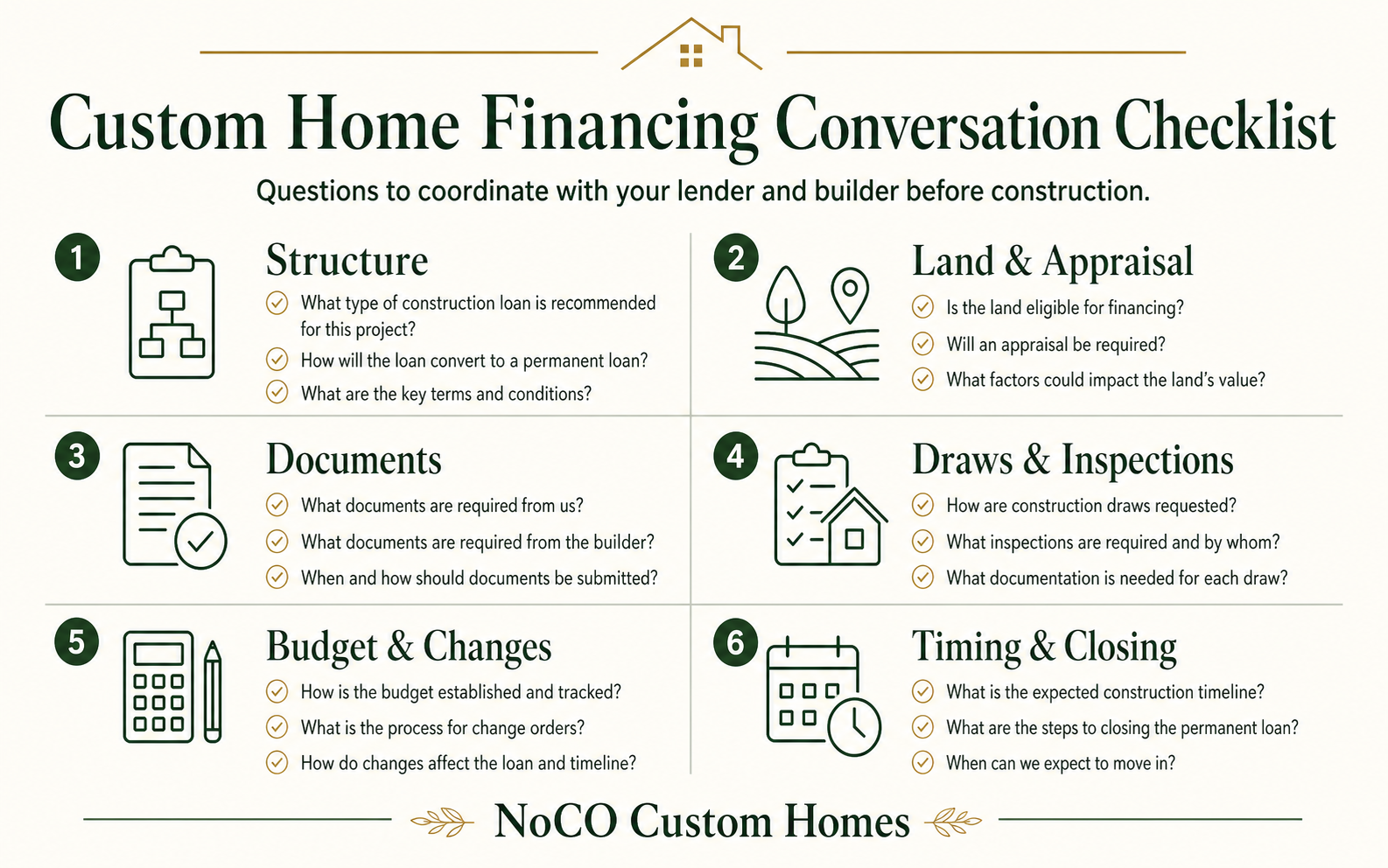
Start by asking whether the lender offers construction-only financing, construction-to-permanent financing, or another structure. If the loan is expected to convert, ask what must happen before conversion and whether any new approval, documentation, appraisal, fee, or closing step may be required.
Ask when payments begin, how payments are calculated during construction, and when principal-and-interest payments for permanent financing would start. Do not rely on a general description from another homeowner or lender; request the terms and process for the program you are actually considering.
Clarify How Land And Appraisal Are Handled
Tell the lender whether you already own the property, are still comparing lots, or hope to include a land purchase in the financing. Ask how existing land ownership or land equity is evaluated and what title, survey, purchase-contract, appraisal, or property documents may be needed.
Because the finished home does not exist yet, ask how the lender evaluates the proposed project. What plans, specifications, budget, builder agreement, site information, and comparable-property information are required for the appraisal or underwriting review? Ask what happens if the appraised value, project cost, and requested loan amount do not align.
Ask What Documents The Lender Needs
Request separate checklists for borrower, property, builder, and project documents. The borrower list may involve financial records and identification. The property and project list may involve title information, a survey or plat, plans, specifications, budget, permits or review status, insurance information, and a construction agreement. The builder may be asked for licensing, insurance, references, financial or project information, and lender-specific forms.
Requirements vary, so confirm who supplies each item, which documents must be final, and which can begin as preliminary information. Ask which missing items prevent underwriting, appraisal, closing, or the first draw from moving forward.
Understand Builder Review, Draws, And Inspections
Ask whether the lender must review or approve the builder and what that process includes. Confirm when the review should begin so it does not become a surprise after plans and agreements are already advanced.
Then ask how construction funds are released. Who requests a draw? What documentation supports it? Does the lender use inspections, percentage-complete reviews, title updates, lien documentation, or other controls? How long can a normal draw take, and how are the builder, homeowner, lender, inspector, and title company expected to coordinate?
The builder should understand the proposed draw process before the construction agreement and cash-flow expectations are finalized. A lender process that looks reasonable on paper still needs to work with deposits, long-lead orders, trade payments, and the project’s actual sequence.
Connect The Loan To The Complete Project Budget
Ask which costs the lender considers part of the financed project and which costs remain the homeowner’s responsibility. Review land, design, engineering, permits and fees, site work, utilities, the house, driveway, outdoor living, landscaping, selections, insurance, lender and title costs, and reserves.
Use the same scope language in the builder proposal and lender conversation. If one budget includes an item and another leaves it outside the project, the totals are not directly comparable. Label confirmed costs, allowances, estimates, exclusions, owner-provided items, and unresolved assumptions clearly.
Ask How Changes And Contingency Are Treated
Custom homes develop as site information, plans, engineering, selections, and trade input become clearer. Ask the lender how it treats contingency and what happens when an approved change increases or decreases the construction contract.
Who must approve a change, what documentation is required, and can the loan amount change after closing? If additional funds are needed, when must the homeowner provide them and how are they documented? Ask these questions before assuming that every later upgrade or unknown condition can be financed.
Review Rates, Fees, Closing, And Timing
Ask for a clear explanation of the interest rate, annual percentage rate when applicable, lender fees, third-party costs, closing costs, payment timing, rate-lock options, extension terms, and permanent-financing process. Compare written information from more than one qualified lender rather than comparing one advertised number.
Discuss the planned design, appraisal, approval, closing, construction, and completion timeline. Ask what could cause an approval or rate commitment to expire and what happens if construction takes longer than the loan’s expected term. Also ask when property taxes, builder’s risk coverage, homeowner insurance, and other project-related obligations begin and who should confirm them.
Prepare A Coordinated Financing Checklist
Before the lender meeting, gather the property address or land status, available survey or plat, preliminary home goals, floor-plan direction, expected builder, early budget, desired timing, and a list of known unknowns. You do not need every final answer to begin the conversation.
After the meeting, organize the lender’s requirements by owner and deadline. Mark what the homeowner provides, what the builder provides, what the design team must complete, and what depends on an appraiser, insurer, title company, utility provider, jurisdiction, or another professional.
The most useful outcome is not a rushed promise. It is a documented next-step plan that connects financing requirements to land review, design, builder scope, budget, and schedule.
Use A Lender-Builder Handoff Table
A lender request becomes actionable when the owner, document, timing, and dependency are visible. Use a table like this after the lender meeting:
| Item | Primary Source | Confirm Before | Dependency To Record |
|---|---|---|---|
| Property and title documents | Homeowner, title team, surveyor, or land professional | Underwriting and appraisal | Ownership, legal description, survey or plat, and lender format |
| Plans and specifications | Architect, designer, engineer, and builder | Appraisal or final approval | Required level of completion and revision control |
| Project budget and agreement | Builder and homeowner | Appraisal, closing, and draw setup | Scope, allowances, exclusions, contingency, and signatures |
| Builder package | Builder | Lender builder review | Exact licensing, insurance, financial, reference, and form requirements |
| Draw package | Builder, lender, inspector, and title team | Each disbursement | Request format, inspection, invoices, lien documents, and processing time |
| Change documentation | Homeowner and builder | Change approval and funding | Contract change, revised budget, lender approval, and owner funds |
NoCO’s public process overview can help organize the builder-side planning conversation, but the lender decides its loan structure, underwriting, appraisal, document, draw, and closing requirements.
Primary Sources And Financial Boundary
- CFPB: What is a construction loan?
- CFPB: Combined construction-loan disclosure guide
- CFPB: Loan Estimate questions and comparison guidance
- CFPB: Appraisals and valuation copies
This page was checked against the sources above on July 20, 2026. It is educational planning guidance, not financial, tax, legal, appraisal, insurance, or lending advice. Programs and requirements vary. Confirm every term, cost, qualification rule, document, deadline, draw procedure, and change requirement in writing with the qualified lender and other responsible professionals.
FAQ
What is a construction loan for a custom home?
It is financing intended to support construction of a home, commonly through funds released as work progresses. Structure, requirements, payments, and permanent-financing options vary by lender.
Should I talk to a lender before buying land?
It can be helpful, especially if you expect financing to include the land or if land ownership may affect the loan structure. Coordinate lender guidance with property due diligence and builder input.
Does the lender need to approve the custom home builder?
Some lenders review builders or require builder documents. Ask the lender about its process and timing before assuming a builder is automatically eligible.
How are construction loan funds paid out?
Funds are commonly released in draws as construction progresses, but request the lender’s exact draw, inspection, documentation, and payment process.
Can changes during construction affect financing?
They can. Ask how the lender treats contract changes, contingency, additional homeowner funds, revised budgets, and approvals before making assumptions.
Related NoCO Resources
- Colorado Lot Feasibility Checklist
- Buying Land Before Hiring A Custom Home Builder
- Custom Home Budget Conversations Before Design
- First Meeting With A Custom Home Builder Checklist
- What Affects A Custom Home Timeline In Colorado?
- VA Construction Loan Information
The Takeaway
Custom-home financing works best when the lender, homeowner, builder, and design team are working from the same property information, project scope, budget assumptions, documents, and schedule. Ask detailed questions early, compare written terms, and confirm every program requirement with the qualified lender providing the financing.