
Quick Answer
Custom home builder reviews are most useful when you read for repeated, specific details rather than relying on the average rating alone. Look for patterns around communication, expectations, changes, problem-solving, budget conversations, schedule updates, workmanship concerns, handoff, and service after move-in. Then turn those patterns into questions for the builder, references, project examples, and the written process.
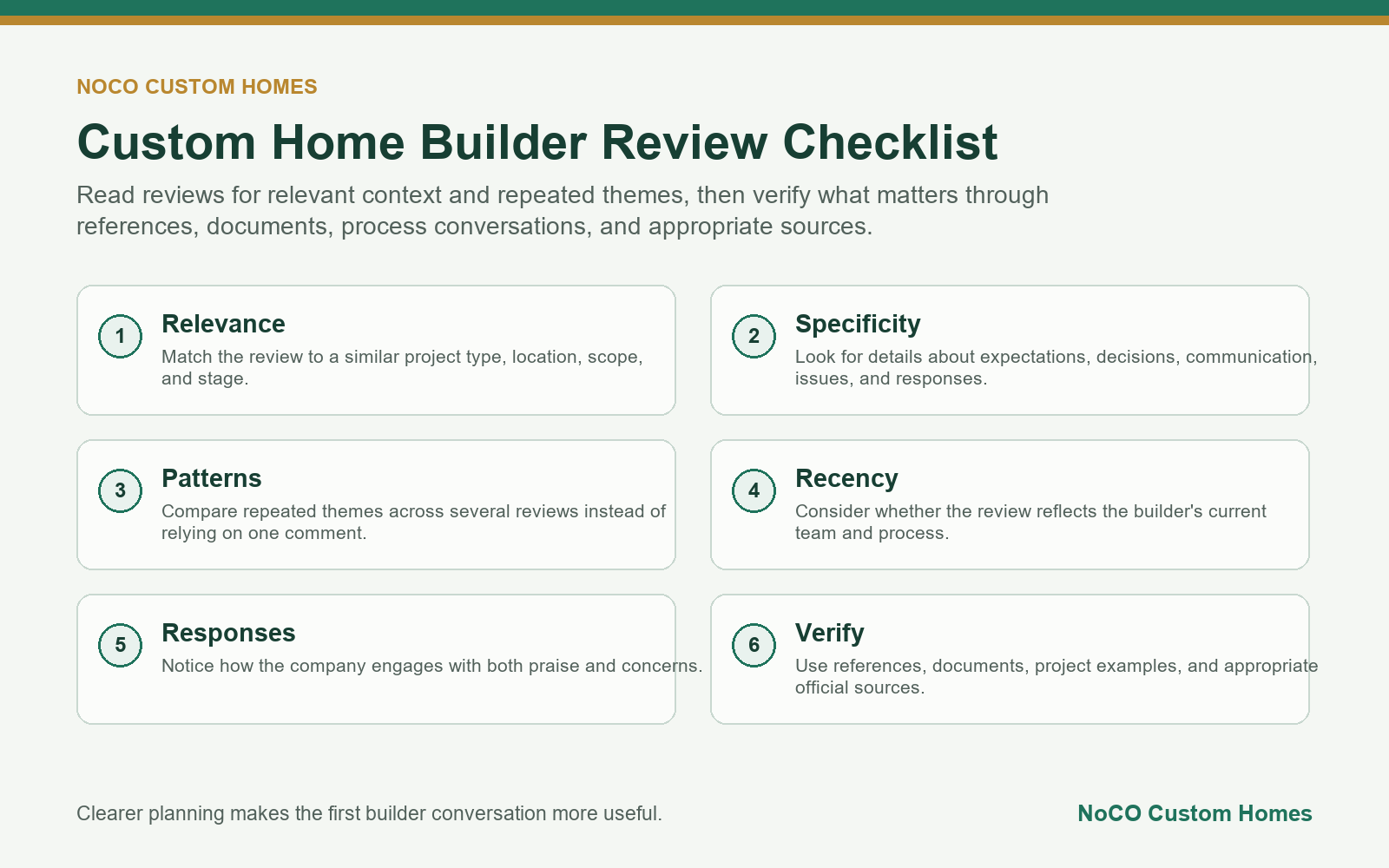
Table Of Contents
- Start With Patterns, Not Stars
- Look For Specific Project Context
- Separate Process From Outcome
- Read Positive And Critical Reviews
- Consider Recency And Company Changes
- Review Builder Responses Carefully
- Verify Beyond Online Reviews
- Turn Review Themes Into Verification Questions
- Use A Builder Review Checklist
- Sources And Review Boundaries
- FAQ
Start With Patterns, Not Stars
A star rating summarizes many experiences into one number, but it does not explain the projects behind it. A builder may have reviews from custom homes, semi-custom homes, remodels, warranty visits, vendors, or interactions that never became a construction project. Begin by asking what the reviews actually describe.
One unusually positive or critical review can be worth reading, but repeated themes are more useful. Note whether several homeowners independently mention clear communication, organized decisions, budget surprises, schedule updates, responsiveness, change documentation, site care, or follow-through. A pattern gives you a topic to verify; it does not guarantee what your experience will be.
Look For Specific Project Context
Detailed reviews are easier to interpret than general praise or frustration. Look for context such as the type of home, location, whether the homeowner already owned land, the design path, the stage of the project, and the part of the builder relationship being discussed.
A review about an available home may describe a different process from a one-of-a-kind home on a complex property. A comment about the sales experience may not explain construction communication. A review written shortly after move-in may answer different questions from one written several years later.
You do not need every personal detail. You need enough context to decide whether the experience is relevant to the project you are considering.
Separate Process From Outcome
A beautiful finished home and a strong homeowner relationship are both meaningful, but they describe different parts of the experience. Read for how the team handled the work as well as how the homeowner felt about the result.
Process themes can include who communicated, how often updates arrived, when selections were due, how changes were documented, what happened when conditions changed, and whether the homeowner understood the next step. Outcome themes can include design fit, daily function, finish concerns, comfort, punch-list work, and service after handoff.
Use NoCO’s Our Process page to compare public process information with the questions raised by reviews. Ask for clarification when the two do not give you enough detail.
Read Positive And Critical Reviews
Positive reviews can show what homeowners valued most. Look for specific examples rather than adjectives alone: a difficult decision that became clearer, a communication habit that reduced uncertainty, a problem that was addressed, or a part of the home that works especially well.
Critical reviews can reveal expectations, friction points, or a mismatch in process. Read the full account and any response without assuming that one side tells the complete story. Ask whether the issue appears isolated or repeated, whether it relates to a project like yours, and what policy or process you would want explained before signing.
Do not try to diagnose responsibility from a short online exchange. Use the review to identify a topic for direct verification.
Consider Recency And Company Changes
Recent reviews may better reflect the current team, process, trade network, market conditions, and service approach. Older reviews can still provide useful history, especially when the same themes continue over time.
Companies can change ownership, leadership, staff, service areas, software, project types, or operating processes. Ask what has changed since the reviews most relevant to you were written. A builder should be evaluated on its current project fit as well as its history.
Review Builder Responses Carefully
A public response can show whether the company acknowledges the reviewer, explains next steps, protects private information, and keeps a professional tone. A response can also provide context, but it cannot prove what happened off the page.
Look for consistency. Does the company respond only to praise, or also engage with concerns? Does it invite a constructive private conversation? Does the tone stay calm and specific? Use those observations to ask how concerns, service requests, and unresolved items are handled during an actual project.
Verify Beyond Online Reviews
Reviews are one part of builder research. Pair them with the builder’s current scope, process, contract documents, specifications, relevant project examples, and references. Where appropriate, verify business, licensing, permit, complaint, or legal information through the responsible official sources or qualified professionals rather than relying on summaries.
When speaking with references, ask questions tied to your priorities:
- How were expectations and responsibilities explained at the beginning?
- How were budget changes, selections, and decisions documented?
- Who communicated regularly, and what happened when an issue arose?
- What would the homeowner clarify earlier if building again?
- How did handoff and post-move questions work?
NoCO’s builder-question guide provides a broader interview framework, while its Testimonials page lets you read homeowner experiences connected to NoCO.
Turn Review Themes Into Verification Questions
Use reviews to build a verification list, not to assign a final verdict. The examples below are neutral practice examples; they are not quotations from NoCO clients or claims about another builder. Record the pattern you observed, how closely it matches your project, and what evidence would help you evaluate it.
| Review theme | What it may suggest | What to verify before choosing |
|---|---|---|
| “We always knew what came next.” | The homeowner experienced a clear communication rhythm. | Ask who sends updates, what they contain, how decisions are logged, and how urgent issues are escalated. |
| “The final cost surprised us.” | Scope, allowances, changes, or owner decisions may not have stayed visible. | Review the pricing structure, allowance definitions, change authorization, owner-provided items, and unresolved site assumptions. |
| “They solved a difficult site issue.” | The team may have coordinated specialists and communicated options well. | Ask for a relevant project example, the builder’s role, the outside professionals involved, and the records used to approve the solution. |
| “Punch-list work took longer than expected.” | Closeout expectations or responsibility may have differed. | Ask how punch items are documented, prioritized, completed, verified, and separated from warranty or owner-maintenance questions. |
| Several reviews repeat the same strength or concern. | A recurring pattern may be more useful than one isolated rating. | Compare dates and project types, ask the builder directly, and check references and current process documents. |
Keep observations and proof separate. A review can identify a useful question, while a reference conversation, current written process, relevant project record, or official lookup can provide stronger context. No single source proves how a future project will perform.
Use A Builder Review Checklist
- Relevance: Is the review about a project type, location, and scope similar to yours?
- Specificity: Does it explain an experience, decision, issue, or response?
- Patterns: Do the same themes appear across several reviews?
- Process: What does it say about communication, changes, updates, and expectations?
- Outcome: What does it say about the completed home, handoff, or later service?
- Recency: Does it reflect the builder’s current team and process?
- Response: How does the company engage with praise and concerns?
- Verification: Which points should be checked through references, documents, examples, or official sources?
Sources And Review Boundaries
The Federal Trade Commission’s consumer guidance on evaluating online reviews recommends checking multiple sources, reviewer history, timing, and unusual review patterns rather than trusting a rating by itself. The FTC also explains the federal Consumer Reviews and Testimonials Rule, which addresses deceptive practices such as fake reviews, undisclosed insider reviews, and review suppression.
For Colorado verification, homeowners can confirm a company’s public registration through the Colorado Secretary of State business database. Contractor licensing is jurisdiction-specific; for example, the City of Fort Collins publishes its contractor licensing and project-verification requirements. Check the government responsible for the actual project location rather than assuming one local record applies everywhere.
This article offers a research framework, not a finding that any particular review is genuine or false and not legal, licensing, or investigative advice. Use qualified professionals and the appropriate agency when a concern requires formal review.
FAQ
Can I choose a custom home builder based on online reviews?
Reviews can help narrow your questions, but they should be combined with project fit, references, process review, documents, relevant work, and direct conversations.
What matters more than a builder’s star rating?
Look for repeated, specific themes connected to projects like yours, including communication, expectations, changes, problem-solving, handoff, and service.
Should I ignore a builder because of one negative review?
Not automatically. Read the context, look for repeated patterns, review any response, and ask the builder how the underlying topic is handled. Serious concerns may also warrant appropriate independent verification.
Are testimonials on a builder’s website useful?
Yes, especially when they provide project and experience detail. Compare them with external reviews, references, current process information, and other verification rather than treating one source as complete.
What should I ask a past custom-home client?
Ask how expectations, budget changes, decisions, communication, problems, handoff, and later questions were handled, and what the homeowner would clarify earlier next time.
Related NoCO Resources
- NoCO Homeowner Testimonials
- Choosing a Custom Home Builder in Colorado
- Questions To Ask Before Choosing a Builder
- Our Process
- Contact NoCO Custom Homes
The Takeaway
Builder reviews are not a scoreboard. They are a source of patterns and questions. Read for relevant project context, repeated process themes, specific outcomes, recency, and professional responses, then verify the points that matter through direct conversations, references, documents, and appropriate official sources. Talk with NoCO Custom Homes about the process and project-fit questions that matter for your Colorado custom home.