
Quick Answer
To evaluate custom-home construction quality, ask how the builder turns drawings, specifications, product requirements, trade work, inspections, and homeowner decisions into repeatable checkpoints. Look for relevant completed and active projects, clear documentation, defined responsibilities, issue tracking, and a practical handoff process. A polished photo or a claim of “high quality” is not enough by itself; the useful evidence is how expectations are established, checked, communicated, and corrected throughout the build.
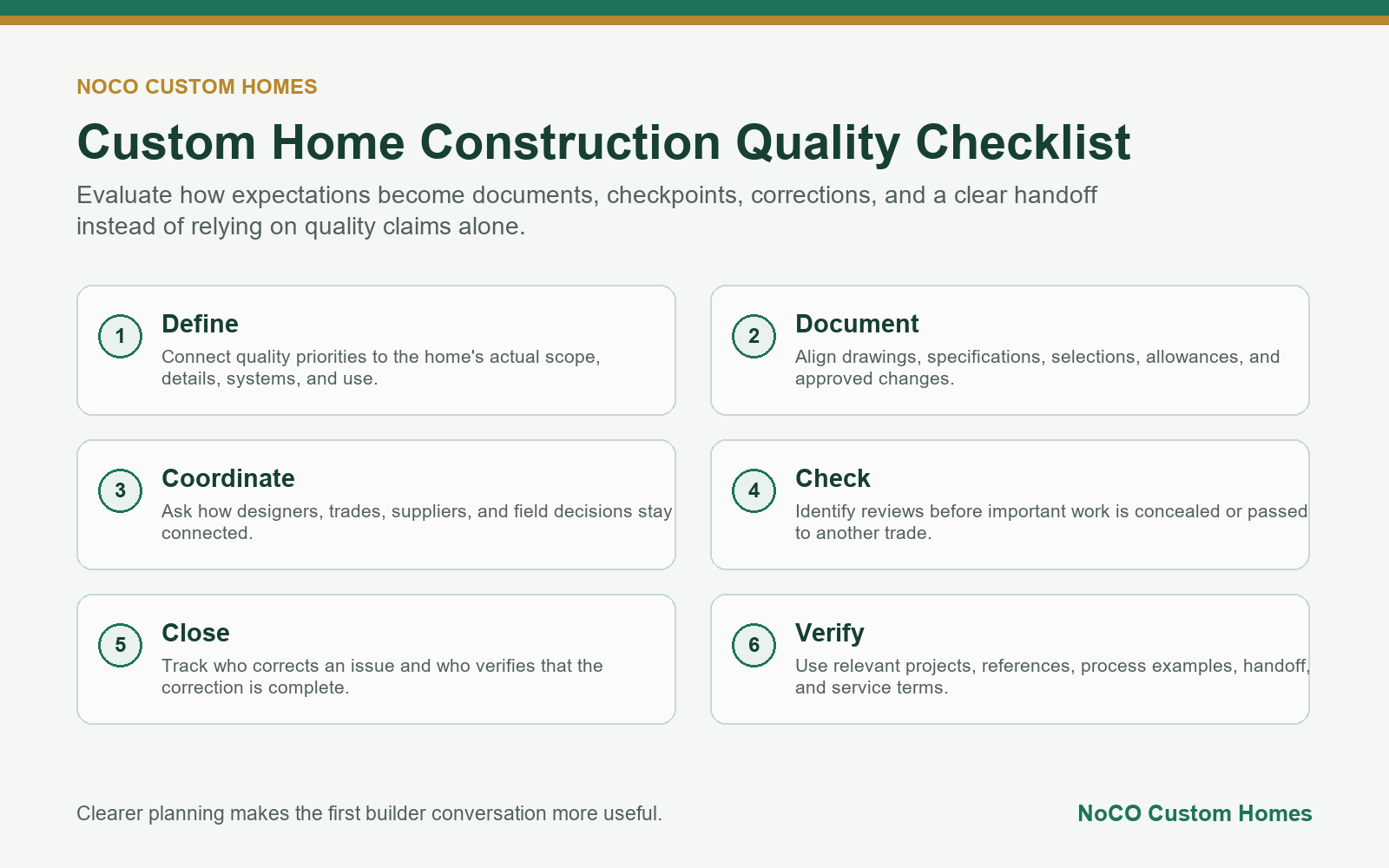
Table Of Contents
- Define Quality Before Construction
- Review Plans And Specifications
- Ask About Construction Checkpoints
- Understand Inspections And Quality Control
- Use A Quality Evidence Ladder
- Look For Issue Closure
- Verify Relevant Experience
- Evaluate Handoff And Service
- Use A Quality Evaluation Checklist
- FAQ
Define Quality Before Construction
Quality is easier to discuss when it is connected to the actual home. It can involve structural coordination, water management, enclosure details, mechanical-system installation, finish alignment, product requirements, daily function, durability, comfort, and the way unresolved items are handled. Not every project uses the same materials, assemblies, tolerances, or performance goals.
Ask the builder how your priorities become part of the drawings, specifications, selections, budget, and construction scope. If a detail matters, it should be discussed early enough for the design team, builder, suppliers, and trades to understand it. Quality cannot be evaluated fairly when the expected result was never defined.
Review Plans And Specifications
Drawings show geometry and intent, while specifications, schedules, selections, and product instructions add important detail. Ask what documents govern the work and how conflicts or missing information are resolved. A builder should be able to explain how the team keeps current information available to the people doing the work.
Useful questions include who reviews constructability, how selections are approved, how substitutions are handled, and how changes reach the field. Ask how allowances and exclusions are documented so that a price comparison does not hide a scope difference. Two proposals can appear similar while describing very different materials, details, responsibilities, and verification.
NoCO’s Our Process page provides a starting point for understanding how planning and construction connect. Use the builder interview to ask for the project-specific detail behind any public process description.
Ask About Construction Checkpoints
Many important details are covered as construction advances. Framing is concealed by insulation and drywall. Waterproofing is covered by finishes. Mechanical, electrical, and plumbing work moves from rough installation to completed systems. Ask when the builder reviews work before the next trade or material makes correction more difficult.
The exact checkpoints vary by project and jurisdiction, so avoid treating one generic list as universal. Ask who performs each review, what documents guide it, whether photos or checklists are used, how incomplete work is recorded, and who confirms correction. The goal is not an impressive number of inspections. It is a clear sequence of responsibility and closure.
Also ask how trade partners are coordinated. Quality can be affected when one trade’s work conflicts with another, when a late selection changes an installed condition, or when a field decision is not reflected in current documents.
Understand Inspections And Quality Control
Jurisdictional inspections, engineering observations, manufacturer requirements, testing, builder reviews, and an owner’s independent professional can serve different purposes. A code inspection is important, but it should not be described as a complete review of every finish, product requirement, design preference, or contract detail.
Ask which inspections are required, which additional reviews are planned, and how the builder responds when an inspector, designer, consultant, homeowner, or trade identifies a concern. The International Residential Code inspection framework identifies stages such as foundation, rough systems, framing, and final inspection, while the actual sequence and adopted requirements depend on the authority having jurisdiction. Fort Collins, for example, connects permit progression with rough-in and framing inspection stages through its residential building-permit guidance. Confirm the current requirements for the project’s exact address rather than applying one city’s sequence everywhere.
If you are considering an independent inspector or specialist, discuss access, timing, scope, communication, and contract terms before construction begins. Independent advice should come from an appropriately qualified professional for the issue being reviewed. The EPA’s Indoor AirPlus verification guidance is a useful example of how a defined program assigns third-party verification roles and retains checklists; it should not be read as evidence that a home participates in that program unless certification is documented.
Use A Quality Evidence Ladder
Match the strength of the evidence to the claim being made. A finished photograph can support a visual observation, but it cannot establish what is behind a wall. A permit inspection can document approval within that inspection’s scope, but it does not replace the drawings, specifications, product instructions, contract requirements, or an independent specialist’s review. Strong evaluation uses several forms of evidence without asking one record to prove everything.
| Claim Or Question | Useful Evidence | What It Does Not Prove Alone | Next Question |
|---|---|---|---|
| The finished work looks consistent | Comparable project photos, close views, a completed-home visit, and references | Concealed assemblies, long-term performance, or every project | Which details can be verified before they are covered? |
| The work matches the agreed scope | Current drawings, specifications, selection records, approved changes, and product requirements | That every installed condition has been checked | Who compares field work with the governing documents? |
| A required stage passed inspection | Permit record and the authority’s inspection result | Every finish, preference, contract item, or voluntary performance goal | What did that inspection cover, and what reviews remain? |
| A system meets a voluntary program or performance target | Named program requirements, qualified testing, signed checklists, and final documentation | Claims outside that program’s scope | Who performed the verification, and where is the result recorded? |
| An identified issue was resolved | Assigned responsibility, correction record, photos or report, and closure confirmation | That no unrelated issue exists | Who verified closure before the next stage or handoff? |
NoCO’s published seven-step process describes design, budgeting, construction, communication, and warranty touchpoints. Treat that public overview as a starting point for project-specific questions, not as proof of an unpublished checklist, inspection result, certification, or condition on a particular home. Ask which records and responsible people apply to the home you are considering.
Look For Issue Closure
Even a carefully planned custom home involves questions and corrections. The quality signal is not a promise that no issue will ever occur. It is whether the team has a workable method for identifying, assigning, correcting, documenting, and verifying issues.
Ask how field questions are communicated, who has authority to approve a solution, and how the homeowner learns about decisions that affect appearance, function, cost, or schedule. Request an example of how a past issue moved from discovery to closure without asking the builder to disclose another client’s private information.
Change management belongs in this conversation. A late change can affect several trades and documents. Ask how the builder evaluates downstream effects before work proceeds.
Verify Relevant Experience
Experience is most useful when it resembles the project you plan to build. Look for homes with comparable site conditions, architectural complexity, systems, materials, scale, and jurisdictional demands. A long company history is meaningful context, but it does not replace relevant examples and current team capacity.
Review both completed and in-progress work when access and homeowner privacy allow. Completed homes show design and finish outcomes. Active sites can reveal organization, material protection, sequencing, communication, and details before they are concealed. No single visit proves the quality of every project, so combine observations with references, documents, reviews, and direct questions.
Use NoCO’s portfolio-photo guide and builder-review guide to turn visual and written evidence into follow-up questions. The Gallery can help you identify project details you want to discuss.
Evaluate Handoff And Service
Quality evaluation continues through completion. Ask how the builder prepares for walkthroughs, records incomplete or corrective items, explains home systems, transfers product information, and distinguishes builder work from manufacturer or trade responsibilities. Clarify the written warranty and service-request process rather than relying on a general promise.
References can help you understand whether the finished home met expectations and how questions were handled after move-in. Ask what the homeowner would define more clearly if starting again, how the punch process worked, and whether communication remained useful after closing.
Use A Quality Evaluation Checklist
- Definition: Are the project’s quality priorities specific enough to document?
- Scope: Do drawings, specifications, selections, allowances, and exclusions align?
- Coordination: How are designers, trades, suppliers, and field decisions connected?
- Checkpoints: What is reviewed before important work is concealed or handed to the next trade?
- Documentation: How are questions, changes, photos, deficiencies, and corrections recorded?
- Verification: Who confirms that an identified issue is closed?
- Proof: Can you review relevant completed work, active work, references, and process examples?
- Handoff: How are walkthrough items, system information, warranty terms, and later service handled?
FAQ
How can I tell whether a custom home builder does quality work?
Combine relevant completed and active projects with specific questions about plans, specifications, trade coordination, checkpoints, documentation, corrections, references, handoff, and service. No single photo, rating, inspection, or claim is complete evidence.
Is passing a building inspection proof of construction quality?
Required inspections are important, but their scope differs from a complete review of contract details, finishes, product instructions, design intent, or homeowner preferences. Ask what each inspection covers and what additional builder or professional reviews apply.
Should I hire an independent inspector for a custom home?
An independent inspection may be useful depending on the project and your needs. Discuss the inspector’s qualifications, scope, timing, site access, reporting, and coordination with the builder before work begins.
What should I look for at an active construction site?
Ask the builder to explain the current stage, plans, material protection, sequencing, temporary conditions, installed details, and how incomplete work is tracked. Avoid judging a temporary condition without understanding the stage and intended next step.
Does more builder experience always mean better quality?
Experience can be valuable, especially on projects similar to yours, but years in business alone do not establish the result. Evaluate the current team, relevant work, process, documentation, references, and project fit.
Related NoCO Resources
- Our Process
- Questions To Ask Before Choosing A Builder
- How To Review Builder Portfolio Photos
- How To Read Builder Reviews
- NoCO Gallery
The Takeaway
Construction quality is not one photograph, inspection, checklist, or promise. It begins with clear expectations and continues through documents, coordination, checkpoints, issue closure, handoff, and service. Ask for evidence that fits your project, and compare builders on the clarity of both their work and their process. Contact NoCO Custom Homes to discuss the planning and process questions for your Colorado custom home.