
Quick Answer
Good communication during a custom-home build gives the homeowner a predictable way to understand what happened, what comes next, which decisions are needed, what changed, and how a change may affect cost or schedule. Before construction, clarify the main contacts, update rhythm, official place for documents and approvals, urgent-issue path, meeting expectations, and homeowner response responsibilities. The best system is not constant messaging; it is timely, organized, documented information that helps the project team make decisions.
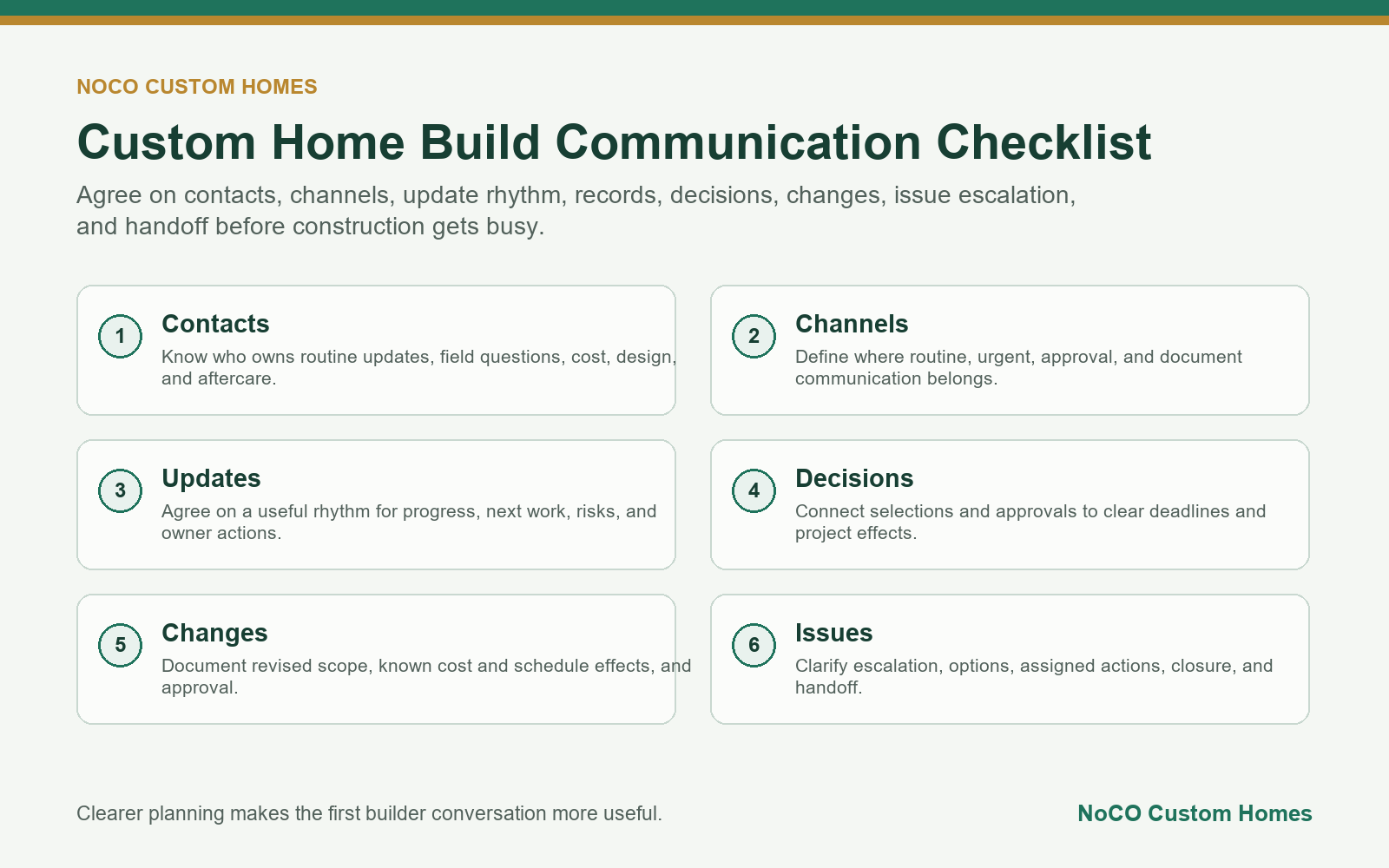
Table Of Contents
- Define Contacts And Channels
- Agree On An Update Rhythm
- How NoCO’s Published System Works
- Keep One Source Of Truth
- Connect Decisions To Deadlines
- Document Changes And Effects
- Communicate Issues With Options
- Clarify Homeowner Responsibilities
- Use A Communication Checklist
- Use A Decision And Escalation Map
- Source And Process Boundary
- FAQ
Define Contacts And Channels
A custom home involves homeowners, the builder, project management, field supervision, designers, consultants, suppliers, and trades. Ask who is the homeowner’s primary contact at each phase, who can approve field decisions, who discusses cost, and who handles service after completion.
Clarify which channel is used for routine questions, approvals, documents, urgent matters, and informal conversation. A text can be useful for quick coordination, but decisions that affect scope, cost, schedule, or design should have an agreed documentation path. Ask how verbal decisions are confirmed.
Agree On An Update Rhythm
Communication should have a rhythm that fits the project and phase. Ask what a normal progress update includes and how often the team expects to meet or report. Useful updates may cover completed work, upcoming work, pending selections, schedule changes, site photos, open issues, and actions assigned to the homeowner.
Construction schedules change because of weather, inspections, site conditions, design clarification, material availability, trade sequencing, and approved owner changes. A schedule update should distinguish a target from a promise and explain what is known, what remains uncertain, and which decision could affect the next step.
How NoCO’s Published System Works
NoCO’s current About page gives homeowners four specific commitments to verify during the project conversation: weekly updates covering what happened, what comes next, and what is expected over the following four weeks; clear prompts for decisions needed to maintain momentum; a focused Project Manager plus Superintendent; and consistent documented communication.
Those details create a better interview than asking only whether a builder communicates well. Ask to see an anonymized example of the weekly update, identify which contact owns office and field questions, learn where approvals are recorded, and confirm how the four-week look-ahead changes when an inspection, material, site, or owner decision shifts the sequence.
Keep One Source Of Truth
Scattered emails, texts, marked-up drawings, and meeting memories can create conflicting instructions. Ask where the current drawings, specifications, selections, approvals, changes, schedule information, meeting notes, and owner decisions live. The tool may be a project platform or another organized system; what matters is that the project team knows which version governs.
Confirm who updates records and how the homeowner can find current information. Ask how superseded documents are identified so an old selection or drawing is not mistaken for the active one.
Connect Decisions To Deadlines
Custom homes require many homeowner decisions. A useful decision request explains what must be chosen, why it is needed, the available information, who can help, the deadline, and what may happen if the decision is late. Homeowners should understand which dates are flexible and which are tied to ordering, fabrication, inspections, or trade sequencing.
Ask for a forward-looking decision list rather than learning about every choice at the last moment. NoCO’s early design-choice guide can help identify decisions that benefit from earlier discussion.
Document Changes And Effects
A change can begin with an owner request, site condition, design clarification, code or inspection requirement, product issue, or coordination conflict. Good communication identifies the cause without turning every change into blame.
Before approval, ask for a clear description of the revised scope and the known cost and schedule effects. Some impacts may still be uncertain; those should be stated. Confirm who is authorized to approve a change and when work can proceed. The budget, schedule, drawings, selections, and field instructions should stay aligned with the approved decision.
Communicate Issues With Options
Problems and surprises can occur even on carefully planned projects. A useful issue update explains what was found, what is affected, whether immediate action is needed, which professionals are involved, what options are available, and what decision or follow-up comes next.
Ask how urgent matters are escalated and how routine deficiencies are tracked to closure. The communication goal is not to eliminate every difficult conversation. It is to bring the right information and people together while there is still a meaningful decision window.
The separate construction-quality guide explains how checkpoints and issue closure can be evaluated without confusing code inspections with a complete quality review.
Clarify Homeowner Responsibilities
Homeowners are part of the communication system. Ask when responses and approvals are needed, who should attend meetings, how questions should be grouped, and whether direct instructions to trades are allowed. Sending a change directly to someone in the field can bypass pricing, design, scheduling, or documentation.
Read updates, review documents, raise concerns promptly, and state priorities clearly. If two owners are involved, decide how conflicting preferences will be resolved and who can provide final approval. Ask for meeting notes or send a concise confirmation when an important decision was made.
Use A Communication Checklist
- Contacts: Who owns routine updates, field questions, cost, design, and aftercare?
- Channels: Where do routine, urgent, approval, and document communications belong?
- Rhythm: What does a normal update include, and when should the homeowner expect it?
- Records: Where are current drawings, selections, decisions, changes, and notes kept?
- Deadlines: How are upcoming decisions and their schedule effects communicated?
- Changes: How are scope, price, schedule, and approval documented?
- Issues: How are concerns escalated, assigned, and closed?
- Handoff: How does communication transition to walkthrough, warranty, and service?
Use A Decision And Escalation Map
| Situation | First Contact | Required Record | Closure Test |
|---|---|---|---|
| Routine progress question | Named project contact | Weekly update or agreed project channel | Question answered or assigned with a next date |
| Selection needed | Selection or design lead and project contact | Option, deadline, budget context, and written approval | Current selection appears in the governing record |
| Field clarification | Project Manager or Superintendent | Current drawing or specification reference and decision note | Field team and office are working from the same instruction |
| Scope, cost, or schedule change | Authorized project and contract contacts | Written change with known effects and remaining uncertainty | Approval, budget, schedule, and field direction agree |
| Quality concern | Project Manager or Superintendent | Location, evidence, assigned owner, correction, and recheck | Issue is verified closed rather than merely discussed |
| Urgent safety or property issue | Agreed emergency contact | Immediate action plus follow-up record | Risk controlled and next responsibility documented |
Source And Process Boundary
A 2026 National Association of Home Builders article identifies hidden costs, process uncertainty, and unclear expectations as recurring homeowner pain points and recommends proactive education. NoCO’s published update structure addresses those concerns with a specific operating rhythm that homeowners can ask to see.
The exact contacts, tools, meeting schedule, response expectations, and contract procedures can vary by project. Confirm the current system in the signed agreement and project kickoff rather than treating this article as a universal promise.
FAQ
How often should a custom home builder provide updates?
There is no universal frequency for every project and phase. Agree on a predictable rhythm and define what the update should contain, then clarify when urgent or decision-sensitive communication happens outside that rhythm.
Should all communication happen through a client portal?
Not necessarily. A portal can organize records, but the important requirement is a shared source of truth and clear channels for documents, approvals, routine questions, and urgent matters.
What should a construction progress update include?
It may include completed work, upcoming work, photos, open issues, pending selections, schedule changes, homeowner actions, and decisions needed. Ask the builder what is appropriate for the project.
How should custom-home change orders be communicated?
Before approval, the homeowner should receive a clear scope description and the known price and schedule effects, along with any remaining uncertainty. Approval and updated project records should follow the agreed contract process.
What if the homeowner and builder disagree?
Return to the contract, current documents, meeting records, and agreed escalation path. State the issue and desired resolution clearly. Legal, technical, or financial disputes may require advice from an appropriately qualified professional.
Related NoCO Resources
The Takeaway
Good builder communication is structured enough to keep decisions, documents, expectations, cost, and schedule information connected. Agree on contacts, channels, rhythm, records, deadlines, changes, escalation, and homeowner responsibilities before construction becomes busy. Contact NoCO Custom Homes to discuss the communication and process questions that matter for your Colorado custom home.