
Quick Answer
A semi-custom home often begins with an existing plan and a defined set of choices, while a custom home begins with a more open conversation about the property, layout, routines, and design priorities. Neither path is automatically better. The useful question is how much flexibility you need, how unusual the property is, and which choices matter most to the way you want to live.
Table Of Contents
- What The Two Terms Usually Mean
- Where The Planning Paths Begin To Diverge
- Start With The Property And Daily Life
- Compare Layout Flexibility Carefully
- Ask What Is Included And What Can Change
- Think Beyond The First Price Conversation
- Questions To Bring To A Builder Meeting
- FAQ
What The Two Terms Usually Mean
The labels can vary from one builder to another, so it helps to ask what they mean in that specific process. A semi-custom home commonly starts with a plan that has already been developed. Homeowners may be able to choose finishes, make selected layout changes, or adjust features that matter to their routines.
A custom home usually starts with a broader set of questions. The property, views, access, daily patterns, room relationships, storage, outdoor living, and design character can all shape the plan from the beginning. That does not mean every decision must be made from scratch. It means the starting point can be adapted more deliberately to the home and the people who will live there.
Both paths can involve meaningful choices. The important part is understanding which choices are open, which are already defined, and when those decisions need to be made.
Where The Planning Paths Begin To Diverge
A semi-custom path can be useful when an existing layout already feels close to what you want. You may appreciate having a real floor plan to react to, a clearer sense of room relationships, and a shorter list of early decisions. The key is to understand how much the plan can change before you become attached to it.
A custom path can make more sense when the property or household has specific needs that should shape the layout early. A distinctive view, a sloped site, a particular garage setup, a private guest area, a work-from-home routine, or an outdoor-living goal can all affect the way the home should be organized.
The distinction is not about choosing the more impressive label. It is about choosing a process that gives the important decisions enough attention.
Start With The Property And Daily Life
Before comparing plan options, think about what the property and your everyday routines are asking the home to do. The driveway approach, privacy, views, sun, wind, slope, outdoor areas, garage access, and the location of main living spaces can all influence whether an existing layout is a comfortable fit.
Then think about the life inside the home. How do you arrive with groceries or gear? Where do guests stay? Do you need an office that can be quiet during the day? How important are storage, a pantry, a mudroom, a workshop area, or an easy connection to a patio? These questions help reveal whether a plan needs minor refinement or a more fundamental change.
NoCO’s Floor Plans can be a helpful place to begin noticing what feels right. The goal is not to find a perfect answer immediately. It is to bring better observations into the planning conversation.
Compare Layout Flexibility Carefully
When reviewing a semi-custom option, ask which changes are truly possible and when they need to be decided. A builder may be able to adjust finishes, room uses, storage, exterior details, or selected features. Other changes may affect the structure, site relationship, roofline, mechanical planning, or the way the home is priced and coordinated.
When considering a custom path, ask how the team will turn your priorities into a plan. You may begin with a collection of plans, a set of inspiration images, or only a list of needs. A useful process helps you sort those inputs into practical decisions about layout, sightlines, privacy, storage, outdoor living, and the relationship between the home and the land.
Explore Custom Floor Plans if you want to see how a plan can become a starting point for a more tailored conversation.
Ask What Is Included And What Can Change
Clear questions make either path easier to compare. Ask for an explanation of the plan, selections, allowances, site assumptions, and the decisions that can affect the scope of work. Ask what is shown in the initial drawings and what needs a separate conversation.
It is also useful to ask how the builder documents changes, how design choices are reviewed, and who helps coordinate the decisions. The answer can tell you a great deal about what the experience will feel like after the first meeting.
A good fit is not only about the plan itself. It is also about whether you understand the decision process well enough to move forward with confidence.
Think Beyond The First Price Conversation
It is tempting to compare the two paths only by the first number discussed. A more useful conversation also considers what the number assumes. The property, the level of plan changes, selections, garage and outdoor-living goals, site work, utilities, and timing of decisions can all matter.
Instead of looking for a universal rule about which path costs less, ask what is included in the starting discussion and what could require more detail. A transparent conversation about assumptions is more useful than a broad promise.
NoCO’s Our Process offers a helpful overview of how planning and collaboration can move forward from the first ideas to a completed home.
Questions To Bring To A Builder Meeting
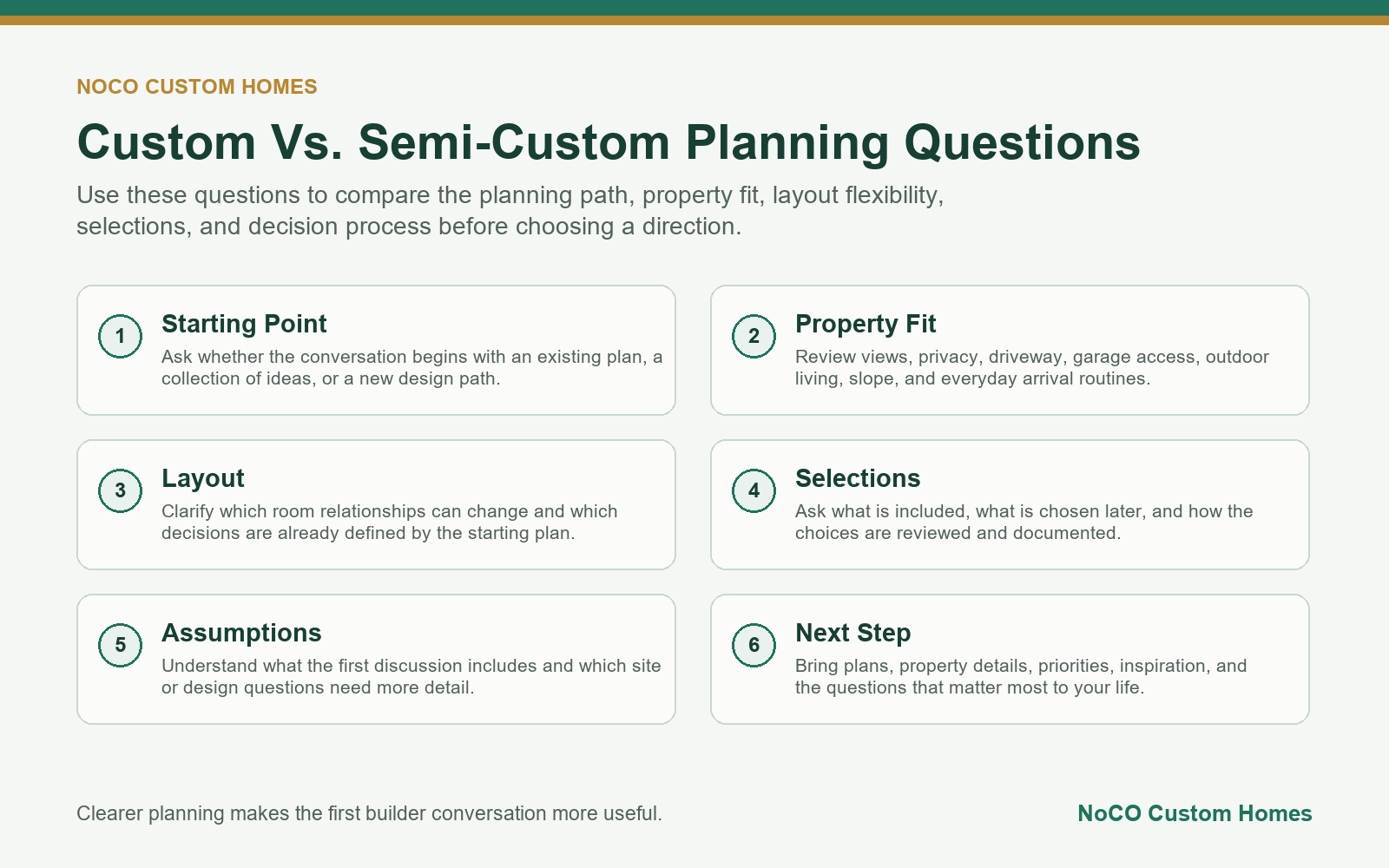
- What is the starting point for this home: an existing plan, a collection of ideas, or a new design conversation?
- Which parts of the plan can change, and which parts need to stay as shown?
- How will the property affect the layout, garage, outdoor spaces, and entry sequence?
- Which choices should be made early to keep the design moving clearly?
- How are selections, changes, and project assumptions documented?
- What should we bring to the next planning conversation?
FAQ
Is a semi-custom home the same as a custom home?
Not always. A semi-custom home commonly begins with an existing plan and a defined set of choices. A custom home can begin with a more open design conversation. The exact meaning depends on the builder, so ask how the process works.
Can I personalize a semi-custom floor plan?
Often, but the available changes vary. Ask which layout changes, selections, exterior details, storage options, and site-related adjustments are possible before committing to a plan.
When does a custom path make more sense?
A custom path can be helpful when the property, views, privacy, garage needs, household routines, outdoor living, or room relationships need more attention than an existing layout can provide.
Is one path always less expensive or faster?
No. The answer depends on the property, the plan, the choices being made, site conditions, and the way the builder defines the scope. Ask for a clear explanation of assumptions rather than relying on a universal promise.
What should I bring to a first planning meeting?
Bring property information if you have it, examples of plans or homes you like, a list of daily-life priorities, questions about the process, and the decisions you want help sorting out.
Related NoCO Resources
- Floor Plans
- Custom Floor Plans
- Custom vs. Production Homes
- Portfolio
- Our Process
- Contact NoCO Custom Homes
The Takeaway
The better planning path is the one that gives the property and your daily life the right amount of attention. An existing plan can be a useful starting point. A more open custom conversation can be valuable when the site or the way you live calls for it. The best next step is a clear conversation about what can change, what is assumed, and how the home can become a good fit.
If you are comparing custom and semi-custom options, NoCO Custom Homes can help you review plans, priorities, and the questions that matter before you move too far into a design decision.