
Quick Answer
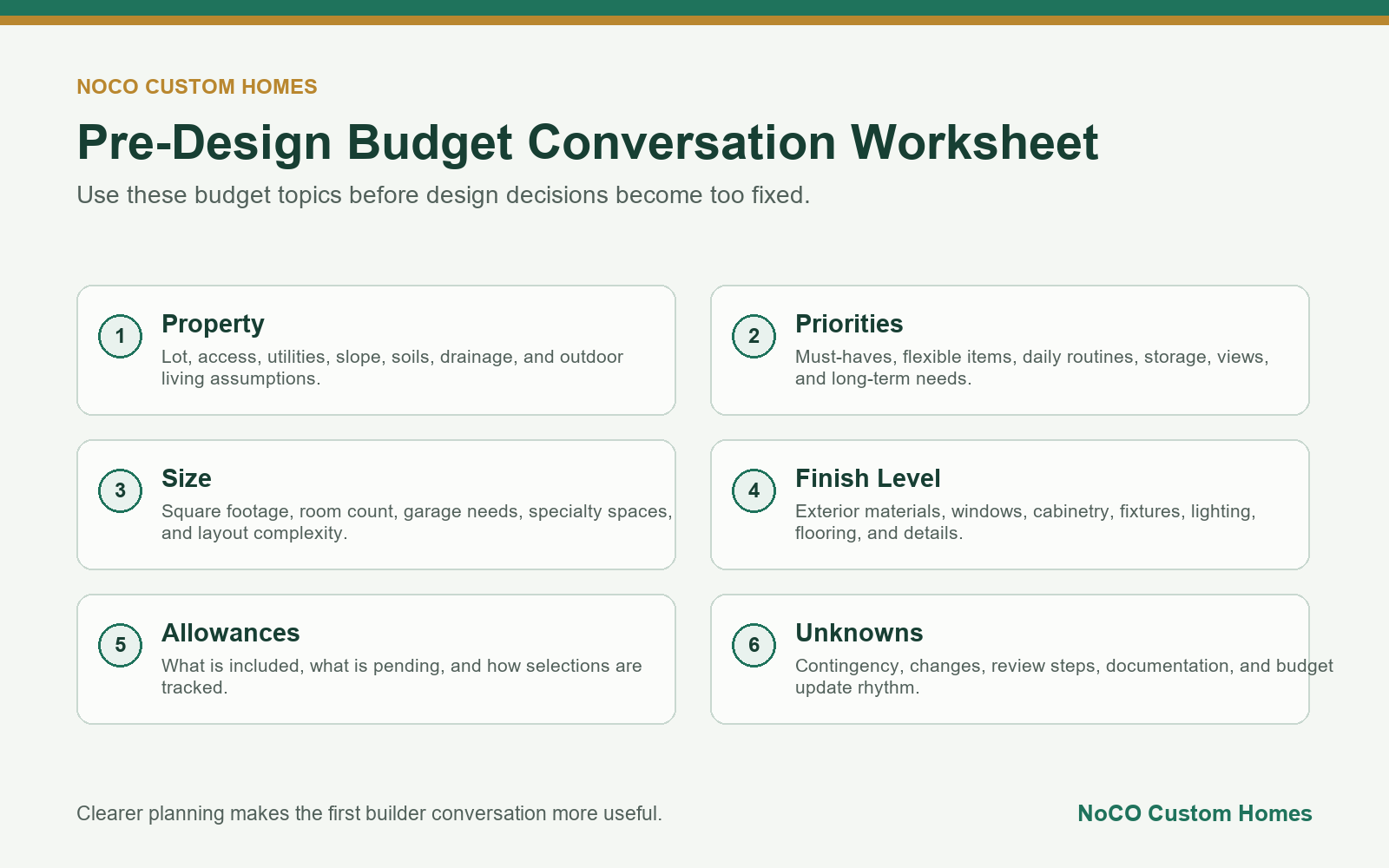
Before design starts, custom home budget conversations should cover the property, target size, design complexity, site work, utility assumptions, finish level, floor plan priorities, outdoor living, selections, allowances, contingency, and how changes will be reviewed.
The goal is not to finalize every number immediately. The goal is to make the biggest assumptions visible early so the home can be planned around real priorities.
Table Of Contents
- Start With The Whole Project, Not Just The House
- Define The Budget Boundary
- Use A Scope-Boundary Worksheet
- How NoCO’s Public Process Frames The Conversation
- Talk About The Property Before Design Decisions Harden
- Define Must-Haves And Flexible Items
- Discuss Size, Complexity, And Finish Level
- Compare Scenarios Before Fixing The Plan
- Ask How Allowances And Selections Are Handled
- Understand Contingency And Unknowns
- Agree On Budget Updates And Decision Ownership
- Sources And Review Boundaries
- FAQ
Start With The Whole Project, Not Just The House
A custom home budget should include more than walls and finishes. Property conditions, site work, utilities, design, engineering, permits, outdoor living, landscaping assumptions, selections, and contingency may all matter.
The point is not to overwhelm the homeowner. It is to understand what is included, what is not included yet, and which numbers are confirmed versus placeholders.
Define The Budget Boundary
Two people can use the same budget number while describing different scopes. Confirm whether the conversation includes land, design and engineering, permits and fees, utility work, the house, driveway, patios or decks, landscaping, window coverings, furnishings, financing costs, and a homeowner reserve.
Write down the boundary instead of relying on a label such as construction budget or all-in budget. When an item is outside the current estimate, identify who is responsible for it and whether the homeowner still needs to plan for it separately.
Use A Scope-Boundary Worksheet
Do not compare one total with another until the rows underneath it describe the same project. Build a worksheet with these fields:
| Scope Group | Record Before Design Advances |
|---|---|
| Land and closing | Included, excluded, already owned, or handled through a separate transaction |
| Site and utilities | Known facts, allowances, exclusions, studies needed, and responsible party |
| Design and engineering | Disciplines included, deliverables, revisions, and fees outside the current scope |
| Home construction | Drawing/specification basis, fixed items, allowances, alternates, and exclusions |
| Owner selections | Allowance basis, installed-cost components, deadlines, and approval method |
| Exterior completion | Driveway, decks, patios, landscape, irrigation, fencing, and outbuildings |
| Professional and finance costs | Permits, reviews, insurance, lender, title, appraisal, and owner consultants |
| Risk and reserve | Known unresolved scope kept separate from genuine unknown conditions |
For each row, label the number as confirmed, quoted, allowance, estimate, owner-provided, excluded, or unresolved. Add the source and date. That is more useful than one confident-looking total built from mixed assumptions.
How NoCO’s Public Process Frames The Conversation
NoCO currently describes a fixed-cost structure for items homeowners cannot control once the home is designed, often around 60% of the budget, with the remaining portion handled through allowances for finishes, fixtures, and other flexible choices. Its About page also says the team stays involved during design so plans remain buildable and aligned with budget priorities.
Those statements are a starting point, not a substitute for the project agreement. Ask the team to map the actual proposal to the worksheet above: which items are fixed, which are allowances, what is outside the price, which assumptions depend on site or design information, and when each category will be revisited.
Talk About The Property Before Design Decisions Harden
The lot can affect budget through access, slope, soils, utilities, drainage, foundation, driveway planning, and outdoor living. Design should respond to the land and budget together.
Before design gets too far, ask whether the property has been reviewed, which site conditions could affect cost, and what still needs to be confirmed.
Define Must-Haves And Flexible Items
Homeowners should identify what matters most before design starts. Must-haves might include main-floor living, garage capacity, guest space, outdoor living, views, kitchen layout, storage, work-from-home space, or long-term flexibility.
Flexible items help the builder and design team protect priorities if tradeoffs are needed later.
Discuss Size, Complexity, And Finish Level
Square footage matters, but it is not the only budget driver. Complexity can come from structure, rooflines, window packages, exterior materials, specialty rooms, cabinetry, outdoor living, and custom details.
Finish level also affects the conversation. It helps to discuss the level of detail and durability desired before selections are final.
Use real examples to describe finish expectations. Portfolio photos, preferred materials, appliance direction, cabinetry details, window goals, and outdoor features give the team more context than terms such as standard, high-end, or luxury, which can mean different things to different people.
Compare Scenarios Before Fixing The Plan
Early design is a useful time to compare a small number of meaningful scenarios. The team might study a simpler footprint versus a more articulated one, finished space now versus planned future space, or one outdoor-living approach versus another.
Each scenario should state what changes, what stays protected, which assumptions are still open, and how the choice may affect design or site coordination. The purpose is not to produce instant exact pricing. It is to understand which decisions have enough influence to deserve attention before the plan becomes harder to revise.
Ask How Allowances And Selections Are Handled
Allowances should be explained clearly. Homeowners should know what allowances are included, what each one covers, and how selections are tracked against them.
Selections can affect both budget and timeline, so ask which decisions need to happen early and how selection changes are documented.
Understand Contingency And Unknowns
Custom homes include variables. Unknowns may involve site conditions, engineering, materials, review steps, or selections that are not yet final.
Contingency is responsible planning. Ask which assumptions are still uncertain, which unknowns could affect the budget most, and how often the budget is updated as details become clearer.
Keep contingency separate from known but omitted scope. A future landscaping plan, an unpriced utility connection, and an unknown subsurface condition are different kinds of budget questions. Naming them correctly makes the next action clearer.
Agree On Budget Updates And Decision Ownership
Ask when the budget will be revisited and what new information should be available at each checkpoint. Useful milestones may follow site review, a preliminary plan, engineering input, key trade feedback, major selections, or a defined pricing package.
Also confirm who maintains the current budget, who can approve a change, where decisions are documented, and how the homeowner will see the effect of an updated assumption. A consistent source of truth helps the design, budget, and decision process stay connected.
Sources And Review Boundaries
The Federal Trade Commission’s contractor guidance recommends comparing written estimates that describe the work, materials, timing, and price rather than automatically choosing the lowest total. A 2026 NAHB discussion of the homeowner expectation gap also highlights hidden costs, uncertainty about process, and unclear finished-home expectations as recurring sources of dissatisfaction.
This article is planning guidance, not a price quote, lending opinion, engineering conclusion, or contract review. Confirm project costs and obligations with the builder and the appropriately qualified property, design, engineering, legal, insurance, and lending professionals.
FAQ
When should I talk about budget with a custom home builder?
Budget should be discussed early, before design decisions go too far. Early budget conversations help connect the property, priorities, design direction, and realistic next steps.
Can a builder give an exact budget before design starts?
An exact budget may be premature before the property, design, site work, selections, and scope are clearer. A builder can still help identify assumptions and budget drivers early.
What affects a Colorado custom home budget the most?
Common budget drivers include property conditions, site work, utilities, home size, design complexity, finish level, outdoor living, selections, materials, and change decisions.
What are allowances in a custom home budget?
Allowances are budget placeholders for selection categories that may not be fully chosen yet. Homeowners should understand what each allowance includes and how final selections are tracked.
How can homeowners prepare for a budget conversation?
Bring property information, floor plan inspiration, must-have spaces, flexible items, budget comfort, timing goals, and questions about land, utilities, design, selections, and process.
Related NoCO Resources
- Choosing a Custom Home Builder in Colorado
- Our Process
- Building On Your Lot in Colorado
- Site Conditions And Custom Home Budget
- Custom Home Timeline in Colorado
- Floor Plans
- Contact NoCO Custom Homes
The Takeaway
Budget conversations are most useful before design decisions become fixed. A clear conversation about land, priorities, scope, selections, allowances, and unknowns helps the home move forward with fewer surprises.