
Quick Answer
Prepare a custom-home lighting brief by describing what people need to see and do in each room at different times. Mark the furniture and work surfaces, note unwanted glare or shadows, and explain how you want to operate the lights. Give those observations to the lighting designer and electrical team before treating a fixture shopping list as a finished plan.
A room can have a striking chandelier and still leave your favorite reading seat in shadow. It can look inviting during dinner but be inconvenient to clean afterward. Those are different lighting jobs. Describing them early helps the design team understand what a beautiful room also needs to do.
Contents
- Start with moments, not fixture quantities
- Place the activity on the room plan
- Describe comfort and appearance separately
- Explain how you want to use the controls
- Prepare a useful lighting brief
- Look at verified NoCO lighting details
- Frequently asked questions
Start With Moments, Not Fixture Quantities
Choose several ordinary situations for each important room. In a living room, that might be reading, conversation, watching a movie, and finding something while cleaning. In a kitchen, distinguish food preparation, an informal meal, and an evening when the kitchen is visible from another room but no longer in use.
Write what should be easy to see in each situation. Include the people whose preferences differ. Someone may like a bright reading area while another prefers a quieter background nearby. The useful question is how the room can accommodate both, not whose preferred brightness should win everywhere.
A brief does not require technical lighting vocabulary. “I want to read in this chair without a bright source in my line of sight” is more useful than an unexplained request for extra recessed lights. Let the professionals translate the task into an appropriate design.
Place the Activity on the Room Plan
Mark the likely position of the dining table, reading chair, desk, bed, mirrors, and work surfaces. Tell the team which locations are settled and which may change. An attractive fixture centered in an empty room may relate differently to the furniture you actually intend to use.
Include the direction a person faces. A desk pointed toward a window creates a different conversation from one facing a wall. A chair used for reading should be identified as that chair, not merely another piece of furniture in the plan.
For display lighting, identify the object or surface you care about and say whether it is already selected. Do not invent artwork dimensions to make a drawing feel finished. A placeholder should remain clearly provisional until the real piece is known.
Daylight is part of the room, but it does not answer every evening question. Review the same activity after dark and at the times you expect to use it. Describe observations from your current home as examples, not as measurements of the house that has not yet been built.
Describe Comfort and Appearance Separately
Keep a short list of lighting you enjoy and lighting that bothers you. Distinguish a fixture’s appearance from the light you experience. You may like a glass pendant’s shape but dislike seeing a bright source from a particular seat.
When visiting a showroom or another space you have permission to view, ask what can be demonstrated. Look from a seated position as well as standing. Notice reflections on a screen or shiny surface. These are observations for the designer, not a diagnosis of the exact product or a guarantee that a showroom will reproduce your room.
Toll Brothers’ room-by-room lighting article focuses on fixture appearance, finishes, and atmosphere. Those are useful selection questions. Add your own activity and viewing-position notes so the conversation also covers the ordinary jobs the room must support.
Review finish samples under the proposed light where the supplier can provide a representative demonstration. Ask the lighting professional to explain product characteristics and compatibility. Avoid choosing every lamp or fixture from an online photograph and assuming the combined result is predictable.
Explain How You Want to Use the Controls
Describe the actions you expect when entering, using, and leaving a room. Do you want to adjust one area without changing another? Should a guest understand the controls without an explanation? Is a phone-based option appealing, or would you prefer the routine to work from an ordinary wall control?
A lighting scene is a coordinated setting for an activity. Lutron’s HomeWorks examples show different settings for entertaining and movie viewing. That illustrates a possibility, not a claim that NoCO includes that system or that every home needs automation.
Write desired behavior before choosing a system. The electrical and technology professionals should confirm equipment, wiring, dimming compatibility, control locations, and any required illumination. For broader infrastructure and support questions, use NoCO’s smart-home planning guide. A lighting brief is narrower: it describes the experience the room should support.
Prepare a Useful Lighting Brief
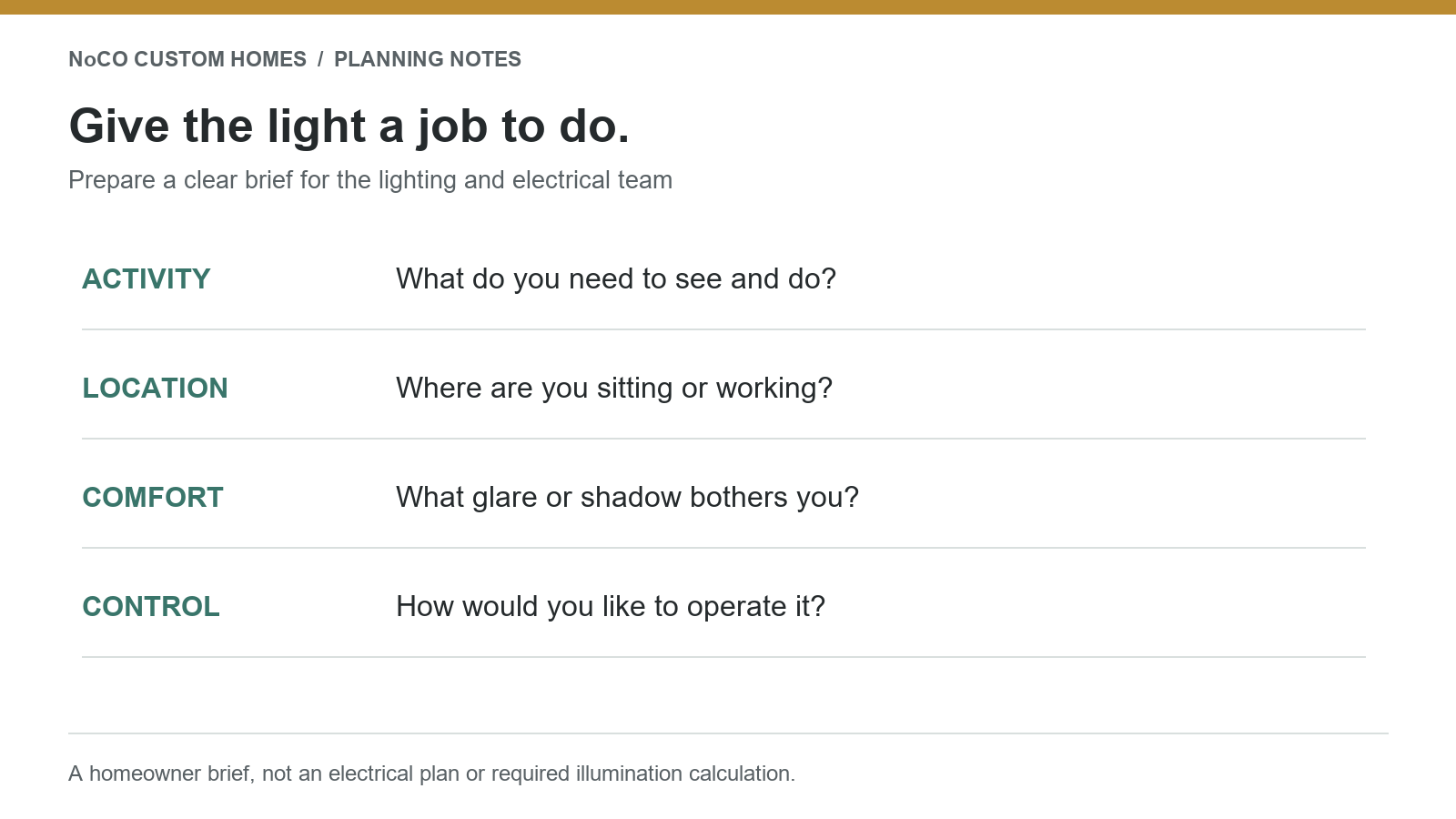
For each priority activity, record six things: room, time, activity, location, an issue to avoid, and the preferred way to control the light. Finish with an open question rather than inventing a technical answer.
Here is a hypothetical living-room entry: “Evening reading in the chair beside the bookcase. Keep the page easy to see without making the television area unnecessarily bright. We want a simple control near the chair. Please show how this can work with the proposed furniture.” This tells the team considerably more than “Add more lights.”
A second entry might address cleanup in that same room. It may call for a different overall setting and a convenient control at the entry. Keeping both entries makes the tradeoff visible instead of expecting one decorative fixture to solve every situation.
After the team responds, record the relevant drawing or selection reference. Keep aesthetic approval separate from technical confirmation. If the table, cabinetry, or room layout changes, ask whether the lighting plan needs another review. The brief should stay connected to the actual room rather than becoming an early document everyone forgets.
Look at Verified NoCO Lighting Details
NoCO’s Modern Prairie Retreat with Statement Blue Cabinetry lists statement pendant lighting and describes layered lighting in the kitchen. Traditional Excellence lists coved ceiling light details. These published features offer different visual starting points.
They do not disclose a complete electrical design or verified control-system brand. When you browse the NoCO project portfolio, identify the effect you like and ask what would be appropriate for your own rooms. The goal is a considered result, not copying unseen specifications from a photograph.
Frequently Asked Questions
Do I need to know how many fixtures each room needs?
No. Begin with activities, furniture, and preferences. The lighting and electrical professionals should determine appropriate quantities, placement, compatibility, and project requirements.
Is a lighting scene the same as a smart-home system?
No. A scene describes a coordinated setting. How it is provided depends on the selected controls and design; a whole-home automation purchase should not be assumed.
Should fixture shopping happen before furniture planning?
Coordinate them. Identify the furniture and activities that influence placement before committing to a fixture solely for its appearance.
Can more lights solve every dark area?
Not necessarily. Explain where the problem occurs and what you need to see. The right response may involve placement, distribution, controls, or another design decision.
Does this article provide an electrical plan?
No. It is a homeowner preparation tool. Electrical design, installation, required lighting, and product compatibility need the qualified project team.
Sources and Related Resources
- Toll Brothers: room-by-room lighting considerations
- Lutron: examples of lighting scenes
- NoCO chef’s-kitchen planning
Takeaway
Give every lighting decision a real activity to support. Bring NoCO a clear room-by-room brief, then let the project professionals coordinate the products and details that turn those preferences into a usable home.