
Quick Answer
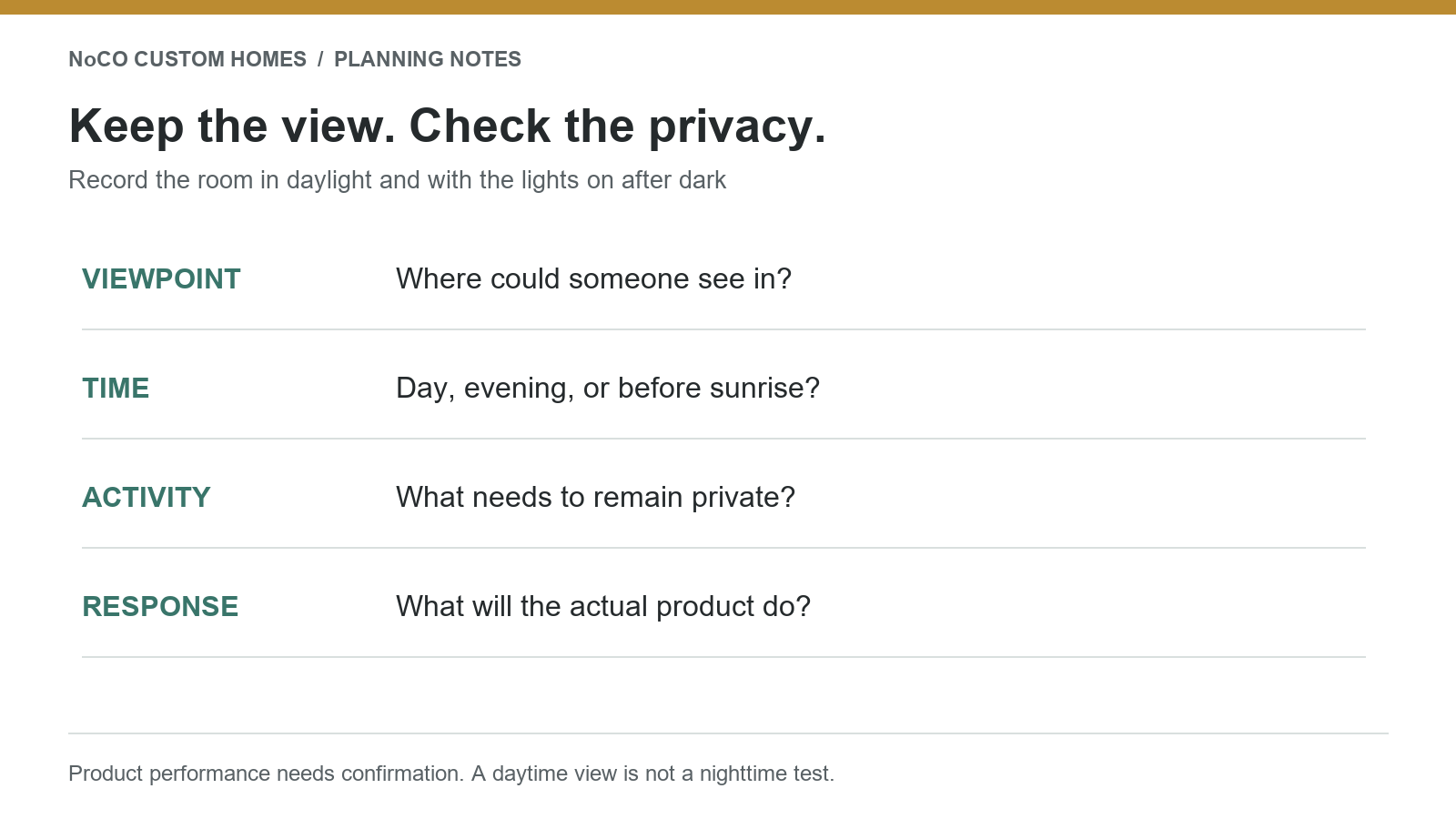
Plan window privacy by identifying who could see into each room, from where, and at what time. Separate daytime glare control from nighttime privacy, then compare window placement, glass, and coverings with the design team. Test the proposed product under the conditions that matter. A shade that preserves a daytime view may not keep a brightly lit room private after dark.
Beautiful glass can connect a home to its surroundings. It can also reveal more of a room than you expect when the lights come on. The useful question is not simply whether a window needs a covering. It is what you want to see, what you want others not to see, and when those needs change.
Contents
- Map the sightlines first
- Treat day and night separately
- Compare responses without losing the room’s purpose
- Ask for a useful demonstration
- Coordinate before the details are fixed
- Use project photos thoughtfully
- Frequently asked questions
Map the Sightlines First
Start with the current site and room plans. Note nearby homes, paths, streets, shared outdoor areas, and any higher viewpoints that the team has identified. Mark which direction you want to enjoy from inside. A mountain view and a neighboring window may affect the same wall in different ways.
Then describe the activity inside. A kitchen breakfast area, a work space, and a room used for changing clothes do not have the same privacy priorities. Write what should remain out of view rather than applying the same solution to every window.
Use observations from places you can lawfully and safely access. Do not enter a neighbor’s property to check a sightline. Ask the designer to explain uncertain relationships using the site information and drawings. Also distinguish current surroundings from assumptions about what will remain unchanged; an undeveloped neighboring parcel is not a guarantee of permanent privacy.
Treat Day and Night Separately
Record at least two conditions for each priority room: daytime use and evening use with interior lights on. Include an early-morning routine if someone is awake before daylight. The visibility that feels comfortable on a sunny site visit may not represent those other situations.
Hunter Douglas explains that solar-screen fabric openness affects view-through and warns that the privacy effect changes when the interior is lit at night. That distinction matters when a product is described as reducing glare or filtering light. Neither phrase alone promises the level of privacy you want.
Keep darkness and privacy separate too. One person may want a bright room with obscured views in, while another wants a darker sleeping environment. Tell the supplier which result matters, and ask how the complete product, edges, and installation affect it. Avoid choosing only from a fabric name or screen image.
Compare Responses Without Losing the Room’s Purpose
There are several conversations to have before defaulting to a covering that stays closed all day:
- Placement: ask whether the room arrangement or window location can address a specific sightline while preserving useful views.
- Glass: discuss whether a privacy-glass option fits the room and what it does to visibility through the window.
- Adjustable covering: compare how the proposed shade or drapery works in its open, partly closed, and closed positions.
- Layered response: ask whether separate daytime and evening functions would suit the household better.
These are options to review, not instructions to change a window opening. Structural design, energy requirements, ventilation, emergency escape where applicable, product compatibility, and installation details remain with the qualified team.
Colorado specialist Elevation Window Designs discusses selecting treatments around room use, light, and views. That room-specific approach is more useful than assuming the entire home needs one fabric. A supplier’s service description is not a statement that NoCO installs or includes those products.
Ask for a Useful Demonstration
Bring a short description of the actual concern to the showroom or supplier. “This room faces a walkway and is used after dark” gives more direction than “We need privacy.” Ask what can be demonstrated and what can only be confirmed at the property.
View the sample from both sides under different lighting when the supplier can arrange it. Explain how close a person might reasonably be to the window and whether the concern is a silhouette, recognizable detail, or a direct view of a particular part of the room. Do not assume one quick glance answers all three.
For a hypothetical bedroom, the household might prefer an open view during the afternoon but require privacy while dressing before sunrise. The selection record should capture both needs. A daytime sample that looks appealing has answered only half the question.
Ask how operation will work in daily life. Who can reach the control? Will furniture make access awkward? If motorization is being considered, discuss its power, control, and support requirements with the appropriate team. Product safety and installation should follow the supplier’s current guidance, not an improvised solution.
Coordinate Before the Details Are Fixed
Window trim, nearby cabinetry, ceiling details, and the space available for a covering can affect the final arrangement. Share the privacy priorities while those elements are still being coordinated. Your team should identify the actual decision deadlines; there is no single schedule that fits every custom home.
Use one record per priority window or window group: room, view to preserve, view to limit, daytime use, evening use, proposed response, and unresolved questions. Keep the exact product and fabric information with any later selection. If a choice changes, revisit both performance and the surrounding details.
NoCO’s broader guide to views, sun, and outdoor living considers how the home responds to its property. This privacy check is the next level of detail for the windows that need particular attention.
Use Project Photos Thoughtfully
In NoCO’s Endless Views project, the published description explains that the owners wanted mountain views from many rooms and that a bi-parting slider connects the great room to the deck. It is a verified example of prioritizing a view.
The description does not establish which privacy coverings were used or how they perform. When browsing the NoCO portfolio, separate the visible feature you admire from details the photograph cannot prove. Ask how a similar idea would respond to your own neighbors, routines, and window conditions.
Frequently Asked Questions
Do solar shades provide privacy at night?
Do not assume they do. View-through fabrics can reveal a lit interior after dark. Ask the supplier to explain and demonstrate the exact product for your situation.
Does light filtering mean room darkening?
No. Treat daylight control, nighttime privacy, and darkness as separate requirements. Ask what the specific product is intended to do and what gaps or limitations remain.
Should all window coverings match?
They can coordinate without being identical. Different rooms and sightlines may call for different functions. Review appearance and performance together.
Can landscaping solve privacy by itself?
It may contribute, but do not assume plants will provide an immediate or permanent screen. Discuss the actual site, seasons, maintenance, and other relevant constraints with the landscape team.
When should we discuss window privacy?
Start during design when room relationships and window placement are being considered. Confirm detailed covering decisions on the project team’s schedule.
Sources and Related Resources
- Hunter Douglas: solar shades and privacy
- Elevation Window Designs: Colorado window-treatment planning
- NoCO floor plans
Takeaway
Keep the view you value while being specific about the privacy you need. Bring NoCO a day-and-night list for the rooms that matter most, then confirm the proposed solution with the professionals responsible for the actual products.